Quick answer
A Twitter / X account suspension is X restricting or locking your account, and unlike a shadowban it tells you. It comes in three states: a limited or locked account (usually a security check you clear yourself), a temporary suspension (time-boxed, with on-screen steps), and a permanent suspension (you have to appeal). To map where the line sits, we ran about 2,000 automated accounts into it and timed each one. The pattern was clean: accounts that fired a burst of actions after sitting dormant died in days, and the single thing that separated survivors from casualties was warming up first and holding a steady human pace from one consistent place. You appeal a real suspension through the official form, once, factually, then wait three to seven business days. Be honest about the odds: X only says it may be able to restore an account, and in our test fewer than 5% of permanently suspended automated accounts ever came back. The best position is not getting flagged at all, which comes down to behaving like a real person on a steady, consistent account.
Not locked, just quiet? Check for a shadowban
What we measured, and the honest caveats
This is the same body of work behind our shadowban and ban study, read from the other end. Across 2025 and 2026 we ran roughly 2,000 automated X accounts as a deliberate red-team exercise, pushing posting, replying, following, link behavior, environment and timing until X acted. That study covered the accounts that survived but got throttled. This one is about the ones that got locked or removed. For each account we logged its birth date, its action stream, its network and device setup, and the exact moment it died, which let us measure survival rather than guess at it.
Three caveats up front, because they change how you should read everything below:
- These were automated accounts. So the rates here tell you what gets an account that behaves like automation suspended, which is the right question if you run your X with any tool, and a useful upper bound for everyone else. A careful human posting by hand has far more slack than our test accounts had.
- Causes overlap. A dying account usually broke more than one rule at once, so we attribute each loss to its most likely primary trigger rather than isolating one variable at a time.
- Survival is a rate, not a promise. The curves below are what happened to our cohorts under deliberate stress. They show direction and relative size, not a guaranteed outcome for any single account.
The obvious question, since our pitch is real accounts at a human pace with no bans: why burn bots at all? Because the only way to build a tool that reliably stays on the safe side of the line is to know exactly where it is. Everything the NotPeople Bridge does is a direct read-out of this experiment.
Suspended, locked, or limited: tell which one first
Before you do anything, work out which state you're in, because the right move is different for each.
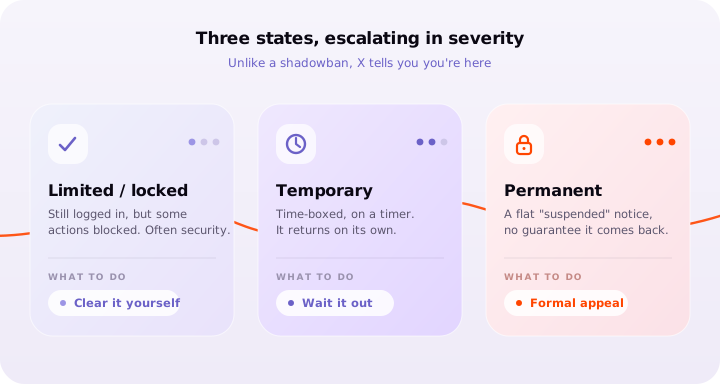 Unlike a shadowban, X tells you you're here. The first two states you usually clear yourself; only the third needs an appeal.
| State | What it is | What to do |
|---|
| Limited / locked | Mildest, often a security check | Verify on screen; usually no appeal needed |
| Temporary | Time-boxed, on a timer | Follow the on-screen steps; it returns on its own |
| Permanent | The serious one, with a policy notice | File a formal appeal, mixed odds |
A limited or locked account is the mildest. You can usually still log in, but some actions are greyed out, or you're asked to verify a phone or email or pass a quick check. This is often a security flag, not a punishment, and you clear it yourself by following the on-screen steps.
A temporary suspension is time-boxed. You'll typically see a message with a countdown or a set of steps, and the account comes back once the clock runs out or you complete what it asks. Read the on-screen notice carefully, because it tells you what to do.
A permanent suspension is the serious one. You get a definitive notice, often naming the policy you're said to have broken, and the account disappears from view to others. This is the case that needs a formal appeal, and it's the one with no guarantee of coming back.
Quick read: if you can still browse but can't like or reply, you're limited. If you hit a wall with a timer, you're temporarily suspended. If you get a flat "account suspended" notice, you're in appeal territory.
How long an automated account lasts
The clearest result in the whole test is a survival curve. Accounts that went dormant and then fired a burst of actions fell off a cliff in the first few days. Accounts that posted cold from day one, with no warmup but a steadier pace, lasted longer but still bled out. Accounts that warmed up first and then held a human rhythm mostly survived the entire run. Same tooling, same content in many cases. The difference was timing and behavior, not what was posted.
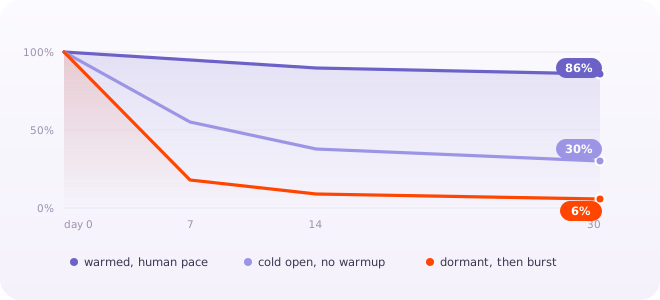 Share of each cohort still live by day. The dormant-then-burst pattern is the cliff; warmup plus a steady pace is the plateau. NotPeople first-party data, ~2,000 automated test accounts run to failure, 2025–2026. Directional.
What moved survival
Once you have a death date on every account, you can ask which choices bought the most life. Four levers separated survivors from casualties more than anything in the content itself. None of them is about what you say. All four are about how the account behaves and where it lives.
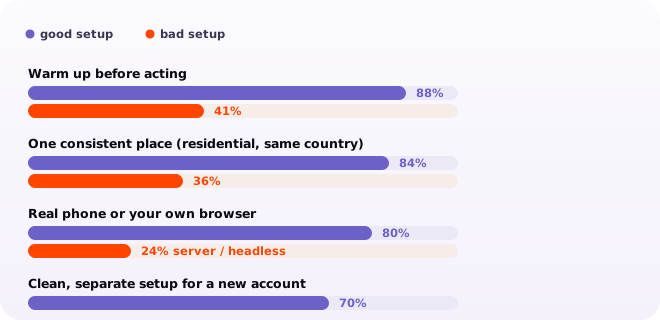 Each lever is the same population split by one choice. Warmup and a stable, residential, single-country environment did the most work; a real device beat a server. Levers overlap; figures are directional, not additive.
The last lever is the replacement-account trap, and it's worth stating plainly because the instinct after a suspension is to make a new account and carry on. We tried exactly that, from the same device and network as the dead account. It almost never held. X links accounts by device, network and other fingerprint signals, so a fresh account born on the ashes of a suspended one reads as ban evasion, which is its own violation. The replacements that survived were the ones started on a genuinely clean, separate environment and warmed up slowly.
The pace threshold
Steady pace is the headline, but there's a sharper number underneath it. We bucketed accounts by how many actions they took in the first hour after a quiet stretch, then looked at how many were suspended within 72 hours. The risk doesn't climb gently. It bends upward hard once the first-hour burst crosses a few dozen actions, which is the exact shape a script produces and a human almost never does.
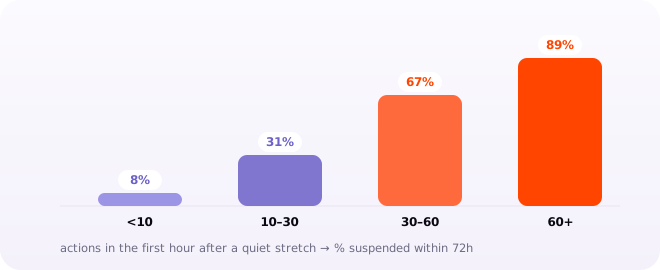 A handful of actions reads as a person checking in; a few dozen in one hour reads as a queue executing. Spreading the same volume across the day kept accounts in the left two buckets. NotPeople first-party data, directional.
Throttle or kill
Not every account that crossed a line died. Many were quietly throttled instead, which is the shadowban side of the same enforcement. Of the accounts that got actioned at all in our test, a little over half were throttled and the rest were locked or removed outright. The difference was mostly how hard and how fast they hit the triggers: a slow drift toward spammy behavior tended to throttle, a sharp bot-like burst tended to kill.
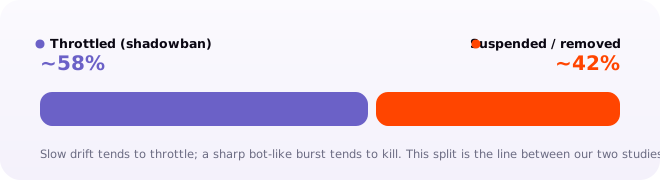 The throttled half is covered in depth in the shadowban and ban study. This guide follows the half that got locked. Share of actioned accounts, directional.
Why X suspends accounts in 2026
X doesn't publish a clean list, and the internal scoring names that circulate online are community guesses, not policy. But across the accounts we lost, the causes were consistent. The full ranked trigger table, with whether each tends to throttle you or kill the account, lives in the shadowban and ban study. The ones that drove suspensions specifically:
- Spam and platform manipulation. The big one. Bursty automated activity, bulk follows and unfollows, the same post or reply fired repeatedly, mass identical DMs. The systems read patterns, not intent, so this catches both spammers and ordinary people whose tooling made them look like one.
- Security and login inconsistency. X watches whether your logins are physically consistent. A sudden login from a new country or device, or activity that looks like the account changed hands, can lock it on security grounds.
- Impersonation and unlabeled parody. A name and photo that look like someone else, or a parody account not clearly marked as parody, can trip impersonation detection even with no intent to deceive.
- Content violations. Posts that break the rules on abuse, hateful conduct or violent content can suspend an account directly, sometimes on a single post.
- Ban evasion. Spinning up a new account to dodge an existing suspension is itself a violation, and X links accounts by device and other signals, which is why the same-fingerprint replacements above died so fast.
"I didn't do anything" is more common than it used to be
This is worth saying plainly, because it's why so many people search this in 2026. Enforcement has scaled up and most of the first pass is software, not a human, and software flags patterns. The public numbers back the size of it: X reported suspending hundreds of millions of accounts for spam and platform manipulation in a single half-year, more than double its pre-Musk rate, and for identity-related suspensions the clear majority were flagged automatically rather than by a person. A classifier that never sees your intent can read a repeated promo, a too-efficient first day, or a sudden change of location as manipulation. That doesn't mean every suspension is a mistake, but a real share start as an automated misread, which is exactly why a calm, factual appeal is worth filing.
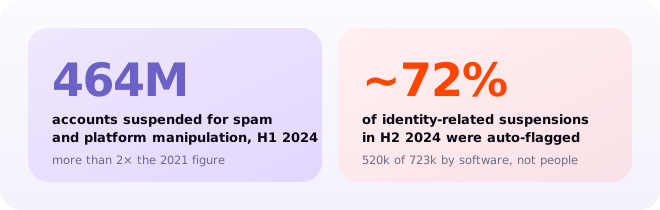 At that volume, a pattern-matching classifier is the first and often only reviewer. Public data: X Global Transparency Report, H1 2024 (via The Drum, Nov 2025); X enforcement on misleading and deceptive identities, H2 2024 (X / Statista, Feb 2025).
How to appeal a suspension
If you're locked for a security reason, you usually don't need an appeal at all, just complete the verification on screen. One caution: if it asks for a visual or identity check, get it right the first time, because repeated failed attempts can raise your risk score and make recovery harder. If you're looking at a real "account suspended" notice, use the formal appeal. The process is short, and each step matters.
- Use the official form only. Go to X's Help Center, Account Access section, and open the appeal form. Never use a third party that promises to guarantee an unban, and never share your password or codes with anyone. Those are scams or a fast way to lose the account for good.
- State your case factually. In plain, professional language, explain what happened and why you think it was a mistake. No emotion, no accusations, no threats. If you did slip, say so briefly and note that you've read the rules and won't repeat it.
- Give evidence. Reference specific post IDs or dates, and attach anything that contradicts the alleged violation. Concrete beats vague.
- Submit once, then wait. Filing the same appeal repeatedly clogs the queue and can delay your review. One solid submission is the move.
- Track it. Replies go to your registered email or message center, so check spam too. You can also follow appeal status through the Help Center.
What an appeal gets you
Most appeals are reviewed in three to seven business days. If your case involves multiple flags or suspected automation, it can stretch to about two weeks, and the account usually stays suspended while you wait. Delays past that are normal too, from spam-filtered emails to support backlogs to manual review.
Now the honest part, with a number attached. We appealed the permanent suspensions in our test, written the careful way described above, and fewer than 5% of them came back. X only states it may be able to restore an account, and for anything that read as automation, "may be able to" does a lot of work. Permanent suspensions for serious violations are not designed to be reversed. And even when an account came back, X did not return its followers or its history with it. File one good appeal and hope for the best, but don't bet anything you can't lose on a single account coming back. A careful, long-established human account has better odds than our test accounts did, but better is not a guarantee.
What not to do
- Don't file appeal after appeal. It slows your own case down. One clear submission, then patience.
- Don't buy followers or engagement to look legit. Bought followers and engagement are themselves manipulation signals and a way to get re-flagged the moment you're back.
- Don't trust unban services. Anyone guaranteeing a reversal, or asking for your password or codes, is a scam. Only X can lift a suspension.
- Don't rush the verification. Repeated failed identity checks can escalate your risk score. Slow down and get it right once.
- Don't immediately spin up a replacement on the same device. It was one of the most reliable ways to lose a second account in our test.
How to stay safe going forward
Whether you get the account back or start fresh, the way to not be here again is the same, and it maps one-to-one onto the survival levers above. It's mostly about not looking like a bot to a system that judges on pattern.
- Warm up before you act. Scroll, read, like a few things, have a session before you post or reply. The cold-open accounts in our test died early; the warmed ones plateaued. A person reads the room first.
- Keep a steady, human pace. Space actions out and never go from days of silence to a burst. This single change separated survivors from casualties more than anything else, and the pace-threshold chart shows how sharply the risk bends once a first-hour burst gets large.
- Stay in one place. One consistent, clean, residential location per account. Don't drive an account from a country it has never seen, and if you move for real, expect a rocky window while X re-learns it's still you.
- Favor a real mobile device. The same behavior survived far more often from a phone than from a server or headless setup. Your own everyday desktop browser is fine too; the risk is automation run from a machine that isn't yours.
- Keep links rare and write in a real voice. Link-heavy, promotional behavior draws both filters and reports, and obvious bot text gets caught for how it reads, not what it says.
- Label parody and grow real engagement. Mark a parody account clearly, and build followers through real participation, not purchases.
This is the whole reason the NotPeople Bridge is built the way it is: it finds the threads worth replying to and drafts in your voice, the action posts from your own browser at a human pace from one consistent place, and you stay on the approve step. It can't make any account immune, nothing can, but it keeps you off every lever that got accounts killed above. If reply-led growth is how you're rebuilding, our reply-led playbook covers why replies out-pull posting for a small account.
Build an account that doesn't get flagged
Source transparency
The survival curve, the four survival levers, the pace threshold, the throttle-versus-suspension split, the replacement-account result and the under-5% appeal-success rate are our own first-party data from running roughly 2,000 automated accounts to failure in 2025 and 2026. They are measured from logged account histories, not estimated, but they are biased toward what catches automated accounts specifically and reflect deliberate stress rather than ordinary use, so read every figure as direction and relative size rather than a precise population rate. The two public figures in the enforcement chart are from X's own Global Transparency Report for the first half of 2024 and X's late-2024 enforcement disclosures, reported via The Drum and Statista. The suspension states, causes and appeal steps are drawn from X's public Help Center guidance, cross-checked against what we saw. X doesn't confirm individual actions or publish its trigger list, so the read on how things look to X is our interpretation, not official policy. Treat this as the current working picture, accurate to mid-2026, and follow the exact steps in your own suspension notice, since X changes process and policy without much warning.
Frequently asked
Can I get my account back after a permanent suspension? Sometimes, but the odds are low for anything that read as automation. You appeal through the official form, and X says it may be able to restore it after review. In our test, fewer than 5% of permanently suspended automated accounts came back. File one strong appeal and be realistic.
Why was my account suspended for no reason? There was usually a reason on X's side that you weren't told clearly. Most suspensions start with automated systems flagging patterns that look like spam, a bot or impersonation, and in late 2024 the majority of identity-related suspensions were auto-flagged by software. The appeal is where you supply the context the classifier never saw.
What gets an account suspended fastest? In our test, a dormant account firing a burst of actions, especially from a server or a different country than it signed up in. Accounts that warmed up first and held a steady human pace from one consistent place survived at far higher rates.
How long does a suspension last? A temporary one is time-boxed and usually shown on screen. A permanent one lasts until a successful appeal, if one ever happens. Reviews typically take three to seven business days, up to about two weeks when automation is suspected.
Will I lose my followers? Possibly. While suspended the account is hidden, and even if it's restored X doesn't promise your followers or data return. It's one more reason not to put everything on a single account.
Can I just make a new account? Not on the same device or network. That reads as ban evasion, and X links accounts by fingerprint. In our test, replacements on the same setup were actioned at a high rate within days. A genuinely separate, clean environment warmed up slowly is the only version that held.
Build an account that doesn't get flagged. The way back, and the way to never be here again, is the same thing that kept our test accounts alive: warm up, hold a human pace, stay in one place, reply in your own voice. That's how the NotPeople Bridge runs your X and Threads, from your own browser with you on the approve step. Not locked, just quiet? Run the free shadowban checker first.