Quick answer
A Twitter shadowban (on X, officially visibility filtering) leaves your account working and tells you nothing; it just quietly cuts your reach. A ban or suspension is different: it locks the account and notifies you. To find the exact line between the two, we ran roughly 2,000 automated accounts into it on purpose. The biggest killer wasn't any single post or word. It was an activity pattern: an account going quiet for days, then firing a burst of actions. About 70% of the accounts we lost died on that rhythm, because to X it looks like a bot waking up. The fix for almost everything below is the same and boring: behave like a person, at a steady pace, from the place the account actually lives. For the automation-specific version, see our field notes on X bans. And no, a Premium subscription does not change any of this; we cover what X Premium does and doesn't do separately. For how ranking and visibility filtering fit together in X's open-source code, see how the X algorithm works and how to reset it.
Check if you're shadowbanned
People still search "twitter," not "x," two years after the rebrand, which is why this guide covers both names.
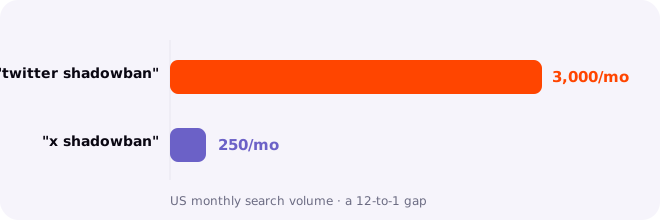 US monthly search volume, a 12-to-1 gap. Compiled from public sources (Growtika / Ahrefs, April 2026).
What we did, and the honest caveats
This isn't compiled from other people's blog posts. Over 2025 and 2026 we ran around 2,000 automated X accounts as a deliberate red-team exercise, pushing posting, replying, following and link behavior to find the precise point where X throttles an account versus kills it outright. Plenty of them died. That was the point: you can't map a cliff without walking some accounts off it.
Three caveats, up front, because they change how you should read everything here:
- These were automated accounts. So our data tells you what gets an account that behaves like automation caught, which is exactly the right question if you use any tool to run your X, and a useful upper bound for everyone else. A careful human posting by hand has far more slack than our test accounts had.
- Causes overlap. A dying account usually broke more than one rule at once, so we attribute each loss to its most likely primary trigger, without isolating variables in a lab.
- One big confound. The accounts that died fastest also tended to run without proper residential proxies, or logged in from a country different from where they were created. We lead with the activity pattern because that's what the timing pointed to most often, though we can't fully separate "the burst" from "the suspicious environment." Both point the same direction: X kills accounts that look like automation waking up in the wrong place.
And the obvious question, since our public pitch is real accounts at a human pace with no bans: why were we burning bots at all? Because the only way to build a tool that reliably stays on the safe side of that line is to know precisely where it is. Everything the NotPeople Bridge does, running from your own browser at a human pace with you on the approve step, is a direct read-out of this experiment.
Shadowban vs ban: two different punishments
Before the triggers, get the taxonomy straight, because the recovery path is completely different for each.
| Shadowban (visibility filtering) | Ban / suspension |
|---|
| What happens | Account works; reach quietly drops | Account locked or removed |
| Does X tell you? | No notice at all | Yes, you're notified |
| Severity | Reach problem | Account death |
| Recovery | Days to ~2 weeks once you stop the cause | Appeal form; often permanent |
| Appeal? | None (officially not a ban) | Yes, with mixed odds |
Most of what creators panic about day to day is the left column. What killed our test accounts was the right column. The two share most of their triggers; the difference is usually how hard and how fast you hit them. If you're already locked out, our guide to X account suspensions and appeals covers the suspension side: the survival curve, the appeal steps, and how the appeals actually went.
The number one killer: dormant, then a burst
The pattern behind roughly 70% of our losses was always the same shape. An account would sit quiet for several days, with no posting, no likes, no scrolling, then come alive with a flood of actions in a short window. That on-off rhythm is the most bot-like thing an account can do, and X treats it as exactly that. A human who has been busy comes back and reads a bit before doing anything; a script comes back and immediately executes a queue.
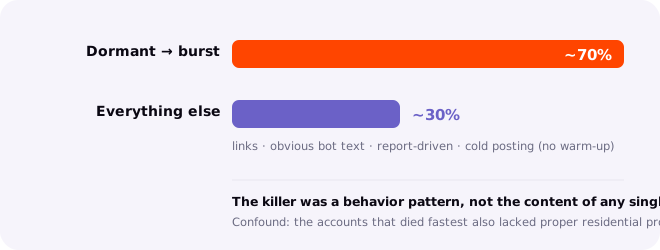 NotPeople first-party data, ~2,000 automated test accounts run to failure, 2025–2026. Share of accounts lost. Directional.
The honest complication: the accounts that died on this pattern were also, disproportionately, the ones without clean residential proxies, or being driven from an IP in a different country than the one they signed up in. So part of what we logged as "burst" may really have been "burst from a suspicious place." We can't cleanly separate the two from our data. What we can say is that the combination of a dormant account, a sudden burst, and a wrong environment was lethal, and removing any one leg of it bought the account more life.
This isn't only about automated accounts. We've watched the same thing hit ordinary corporate accounts: in a few cases the only thing that changed was the founder or CEO relocating to another country and running the company account from the new place, and the account got flagged anyway, with no shift in posting, behavior or content. It fits the rest of the picture. X reads a sudden change of location as a possible account takeover, no matter who you are. By the platform's logic the safest account is one that stays in a single place and never moves, which is why a stable, consistent IP and device matter as much as your posting pace.
If you run more than one account, this is the part that matters most for you. The fastest deaths in our test were accounts acting from the wrong country or without a stable residential IP. Keep each account in one consistent place and warm it up before it does anything. The proxy and geo signal appears to compound the activity-pattern signal rather than add to it linearly.
Everything that got accounts banned, ranked
X doesn't publish its trigger list, and the internal scoring names that circulate online are community guesses rather than policy. But across ~2,000 accounts the behaviors that set things off were consistent. Here they are, with whether each tends to throttle you first (shadowban) or kill the account (ban):
| What we did to trip it | How it reads to X | Risk |
|---|
| Dormant for days, then a burst of actions | A bot waking up and running a queue | Ban |
| Acting from the wrong country / no stable residential proxy | A hijacked or farmed account | Ban |
| Posting or replying cold, no scroll or likes first | A script that only publishes, never reads | Ban |
| A link in most posts and replies | A promo or spam account | Both |
| Obvious bot text: replies that lagged or cut off mid-sentence | Low-quality automation, not a person | Both |
| A promotional reply that went viral, then drew reports | A trust-and-safety problem worth removing fast | Ban |
Two of those deserve a note. The bot-text deaths were avoidable and instructive: several accounts got flagged not for what they said but for how it read, with replies that visibly broke, lagged, or stopped mid-phrase, the tells of cheap generated text dropped into a box. Generic AI output gets caught; text in a real voice does not. And the viral-promo-reply death is the one path here that is human-driven rather than algorithmic: a salesy comment got enough eyes that people reported it, and the reports, not a model, took the account down. Reach plus a promotional tone is its own risk.
The three ways X shadowbans you
When an account doesn't die but goes quiet, it's one of these three. None of them shows up on your own screen.
Search ban. Your posts drop out of X search. Your own timeline looks normal, so you may never notice from where you sit, but anyone searching your topic, or even your exact words, never finds you. This is the one you're least likely to catch on your own.
Reply deboost. Your replies get buried under "show more replies" in the threads you join, or hidden from anyone who doesn't already follow you. For a founder who grows by replying to bigger accounts, this is the one that hurts, and it's the most common form in 2026. Reply-led growth is the whole game when you're small, which is why we wrote up the reply-led playbook separately.
Throttled reach. No ban on anything specific, just less of everything. X shows your posts to a sliver of your followers and your impressions crater, with no notice and no reason given. A 50% or worse drop in impressions over a few days, with no change in what or how often you post, is the usual fingerprint.
One note on mechanics: in January 2026 X swapped its recommendation engine for a Grok-based model, so the hand-tuned scoring rules people still quote describe the legacy system rather than what runs today. The behaviors that trip it are the ones in our table, and those didn't change.
How to check if you're shadowbanned
The fast way is a free checker. Our Twitter / X shadowban checker pulls your recent posts and tests the things X hides from you: whether you show up in search, whether your replies surface in threads, how far your posts reach, and how your engagement compares to normal. You get a health and engagement score in about thirty seconds, with no login, no card, and as many handles as you want.
If you'd rather confirm it by hand, three tests do most of the job:
- Logged-out search. Open a private window, go to x.com, and type your handle into search. If your account doesn't show up in autocomplete, and your recent posts don't appear when you search their exact text, you're likely search-banned.
- The from: operator. In that same logged-out window, search "from:yourhandle" plus a phrase from a recent post. Empty results where your post should be points to a search ban.
- Reply placement. Post a reply on a busy thread from a large account, then have someone who doesn't follow you load that thread while logged out. If your reply is collapsed under "show more replies" or missing while others show, that's reply deboost.
- The quote counter. Quote a post, then open its Quotes list logged out. If the number went up and your quote is not in the list while it sits on your own profile, the account is restricted the same way; the full walkthrough, including the cases that are only a block or a private account, is in X quotes not showing.
One honest caveat: X sorts replies by relevance anyway, so a brand-new account replying to a huge account will sit low for ordinary reasons. The reply test is most reliable when your replies used to show and suddenly don't.
Run the free checker
How long a shadowban lasts
Most soft shadowbans are temporary. Once you stop whatever triggered it, reach usually returns inside a few days to about two weeks, and the window tends to track the type of filter you tripped: a search-suggestion ban often clears in 12 to 48 hours, a full search ban in 2 to 7 days, a ghost ban in 3 to 14 days, and a reply deboost can run for several weeks. The catch, which we watched happen repeatedly in testing, is that the clock resets every time you trip the trigger again. Keep posting in bursts or following aggressively and you can sit in a rolling shadowban for months without it ever being a single ban you could point to.
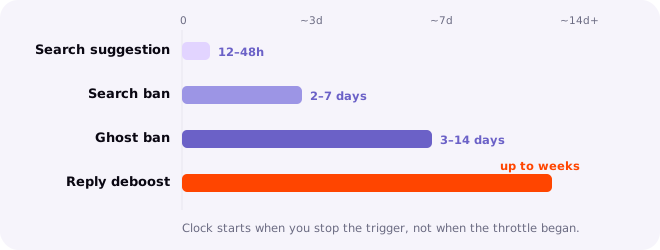 Recovery windows operators report most consistently, cross-checked against our recovered accounts. Directional, not a measured distribution.
Reddit has its own version of the same invisible punishment, with different triggers and no timer at all; the walkthrough for that side is Reddit shadowban: how to check, avoid and recover.
How to fix a shadowban and stay off a ban
There's no button and no appeal for a soft shadowban, because officially it isn't a ban. You fix it by removing the cause and letting the account recover. A full suspension does have an appeal form, but the reliable path is not tripping the triggers at all. Either way the discipline is the same, and it's what kept our surviving accounts alive:
- Warm up before you act. Scroll, read, like a few things, have a session, before posting or replying. The cold-open accounts in our test, the ones that went straight to publishing, died early. A person reads the room first.
- Keep a steady, human pace. Space actions out; never go from days of silence to a burst. This single change separated our survivors from our casualties more than anything else.
- Stay in one place. One consistent, clean residential location per account. Don't drive an account from a country it has never seen, and if you do move for real, expect a rocky window while X re-learns that it's still you.
- Favor a real mobile device. In our runs the same behavior survived far more often from a phone than from a desktop. The native app on a real phone carries the device and network fingerprint X trusts most, and it's the hardest thing to mistake for a script. Your own everyday desktop browser is fine too; the risk is automation run from a server or a headless setup, not your real machine.
- Keep links rare, and write in a real voice. Most replies should link to nothing, and they shouldn't read like generated filler. Both link-spam and obvious bot text got accounts caught.
- Win reach back through real replies. Cold bulk posting into a throttled account does nothing. Useful replies in live conversations, in your own voice, are how an account rebuilds signal and gets seen again.
That last point is built into the ranking model's math. In X's open-sourced ranking code (twitter/the-algorithm), a reply that earns a reply back carries roughly the weight of 150 likes, the highest-value action in the model, which is exactly why a reply deboost is so costly and why replies are how you climb back.
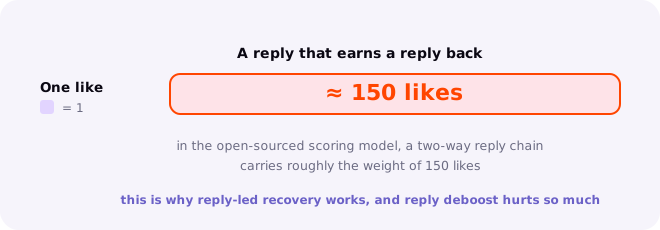 Reflects the open-sourced model (twitter/the-algorithm); live production weights are unpublished.
The reach math has also tilted hard toward paying accounts. Premium+ accounts average over 1,550 impressions a post, standard Premium around 600, and a regular account under 100, with non-Premium posts carrying links sitting near zero median engagement since March 2025 (per Buffer's analysis of 18.8M posts). A regular account has no reach to spare, so anything that reads as automated costs more than it used to.
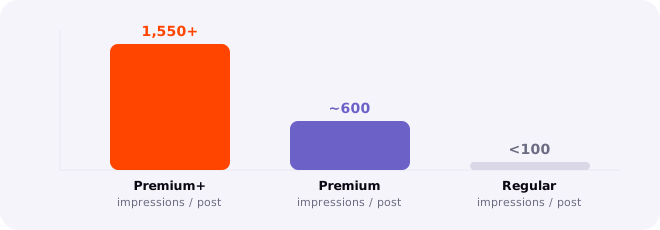 Per Buffer's analysis of 18.8M posts from 71,000 accounts, Aug 2024–Aug 2025.
This is the whole reason the NotPeople Bridge is built the way it is: the agents find the threads worth replying to and draft in your voice, the action posts from your own browser at a human pace from one consistent place, and you stay on the approve step, which keeps the behavior on the right side of every line in the table above.
Source transparency
The ban-trigger findings, the ~70% figure, and the proxy and geo confound are our own first-party data from running roughly 2,000 automated accounts to failure in 2025 and 2026. The corporate-relocation cases and the mobile-versus-desktop pattern are smaller sets of real accounts we observed, not part of the 2,000-account count, and we report them as directional anecdote rather than measured rate. They are directional rather than a controlled lab study, and biased toward what catches automated accounts specifically. X doesn't confirm individual actions or publish its trigger list, so the "how it reads to X" column is our interpretation, not official policy. The shadowban mechanics (the types, the reply multiplier, the Premium reach gap, the recovery windows) are drawn from public sources and cross-checked against our surviving accounts. Treat all of this as the current working picture, accurate to mid-2026, since X changes how it filters without announcing it.
Frequently asked
What is the difference between a shadowban and a ban? A shadowban leaves the account working and tells you nothing; it just cuts your reach. A ban or suspension locks the account and notifies you. One is a reach problem you recover from in days; the other is account death you have to appeal, which we cover in the account-suspended and appeal guide.
What gets a Twitter / X account banned fastest? In our test, the dormant-then-burst activity pattern, going quiet then a flood of actions, was behind about 70% of the accounts we lost, especially when the account was also acting from the wrong country or without a clean residential proxy.
Can moving country get my account banned? It can trigger a review. We've seen legitimate corporate accounts get flagged when the founder relocated and started running the account from a new country, with nothing else changed. X reads a sudden location change as a possible takeover, so expect a rocky window and keep the rest of your behavior steady when you move.
Is X safer from my phone than my computer? In our experience, yes, by a wide margin. A real phone running the native app carries the most trusted device and network fingerprint and rarely reads as automation. A desktop gets riskier the further it drifts from your own everyday browser, and a server or headless setup is the riskiest of all.
How long does a Twitter / X shadowban last? Most soft shadowbans lift within a few days to about two weeks once you stop the trigger. A search-suggestion ban can clear in 12 to 48 hours; a reply deboost can run for several weeks. The clock resets each time you trip the trigger again.
Why was my account suspended for no reason? Suspensions usually trace to behavior that reads as automation or spam even when each action felt harmless: a burst after dormancy, links in most posts, generic bot-like text, a promotional post that drew reports, or a sudden change of location. X notifies you of a suspension but rarely names the exact cause. Our suspension and appeal guide walks through what to do next.
Can X tell I checked for a shadowban? No. A checker reads public signals about your account, the same things anyone could see, and X has no way to know you ran it.
Can you appeal a shadowban? There's no appeal for a soft shadowban because officially it isn't a ban; you remove the cause and wait for reach to recover. A full suspension has an appeal form, but the faster path is not tripping the triggers in the first place.
How do I know a shadowban lifted? Re-run the check. When your handle shows in logged-out search again, your replies surface for non-followers, and your impressions return to their old baseline, the filter has come off.
Check your account in thirty seconds with the free Twitter / X shadowban checker, no login or card. If your reach is throttled, the way back is the same thing that kept our test accounts alive: a human pace and real replies, which is how the NotPeople Bridge runs your X and Threads, from your own browser with you on the approve step.
Run the free shadowban checker