Quick answer
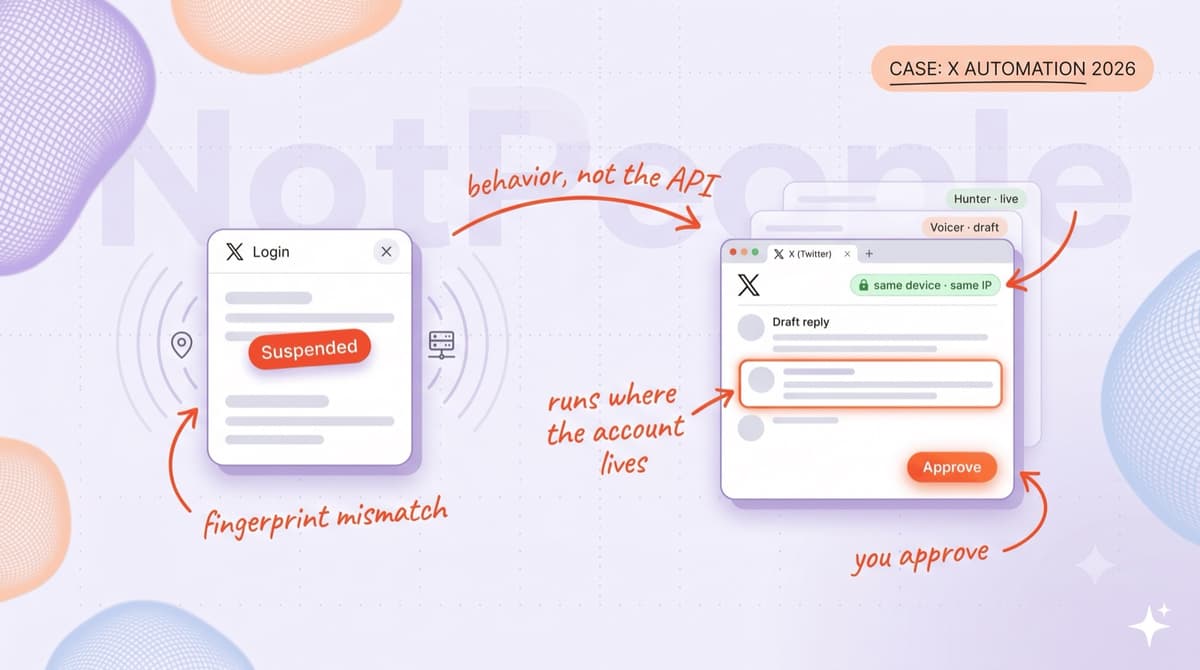
What gets you banned is behavioral, not which API you used. In practice the top trigger is a fingerprint and location mismatch: an account created in one place, then hit with a burst of actions from a server or a different country, often after sitting idle for days. Robotic text, links in most of your comments, hard-sell replies that draw reports, and posting cold with no warmup do the rest. Automation is safe to the degree it's indistinguishable from you: your device, your IP, a human pace, your real voice. The official API does not buy you out of any of that, and running from your own browser on a clean fingerprint covers the single biggest risk on the list. The shadowban side of the same data, and what burning roughly 2,000 accounts taught us about the exact line between throttled and dead, is in our Twitter / X shadowban and ban study.
What actually gets accounts banned, in order
This is from our own operations, not a policy page. We've run X and Twitter automation across registration methods, countries, and activity levels, and tracked which accounts got flagged and which ones aged quietly. The same short list did almost all the damage, and most of it traces back to one thing: the account acting like something other than a real person on a real device.
- Fingerprint and location mismatch. By a wide margin the biggest one. An account built in one country, then driven hard from a server or another region, with no consistent IP behind it. In our data this pattern, the account waking up and acting from somewhere it has never been, accounts for the large majority of bans. If proxies or device are wrong, almost nothing else matters, this alone ends the account.
- Dormant, then a burst. An account that sits with no posts and no likes for days, then suddenly performs a pile of actions, reads as a farmed account that just got switched on. The spike is the tell, not the volume.
- Posting cold, no warmup. Going straight to posting with no organic behavior first, no scrolling the feed, no likes, looks like a script that only knows how to publish. Real accounts read before they talk.
- Too many links. Links in most of your comments and posts is a classic promo signal. Heavy link use was a consistent trigger in our accounts.
- Obviously robotic text. Comments that are generic, oddly paced, or cut off mid-sentence get clocked as a bot by people first, then sink under no engagement. We watched accounts flagged on text quality alone.
- Hard-sell that pulls reach. A promotional comment that suddenly gets a lot of views collects reports, and the reports are what end the account, not the algorithm. The more reach a salesy comment gets, the faster it draws them.
In one table:
| What flags the account | How it reads to the platform | How to not trip it |
|---|
| Acting from a different IP or country than the account was made on | A hijacked or farmed account | Run from your own device and IP, the one the account already lives on |
| Going quiet for days, then a burst of actions | A dormant account that got sold and switched on | Stay active at a steady daily pace, no spikes from zero |
| Posting cold with no scrolling or likes first | A script that only posts and never behaves | Warm up first: scroll, read, like, then post |
| Links in most of your comments and posts | A promo or spam account | Keep links rare and earned, most replies link to nothing |
| Replies that read like a bot, generic or cut off mid-sentence | Low-quality automation | Your real voice, full sentences, on topic |
| A hard-sell comment that suddenly pulls big reach | Ad spam, which invites reports | Don't pitch in replies, reports end these accounts, not the algorithm |
The official API is not the safety you think it is
Most guides tell you the official API is the safe path and everything else is the danger zone. We found the method was never the line. The accounts that got banned got banned for behavior, a burst from the wrong IP, a dormant account waking up, robotic text, not for which endpoint sent the post. Accounts driven through a normal logged-in browser, carrying a real fingerprint and a real history, held up where clean API setups on mismatched IPs did not.
Here's the honest both-sides of it. On paper, X's automation rules prefer the official API and look unkindly on anything that drives a browser. In practice, enforcement reads the fingerprint and the behavior first. Both are true at once. We're not telling you the policy says browser automation is welcome. We're telling you what actually moves the ban needle, and on every account we've run, that was behavior and fingerprint, in that order.
Run from your own fingerprint
Since the mismatch is the biggest killer, the fix is simple to state: every action should come from the same device, IP, and session the account already lives on. No server farm in another country, no fresh login from a new region, no proxy stack that the account has never seen. An account that always acts from the place it was born is the hardest thing on this list to flag, because there is nothing inconsistent to catch.
This is what the NotPeople Bridge extension is for. The Bridge runs inside your own logged-in browser, on your own device and IP. Every action carries the same fingerprint, session, and location the account already has. Nothing routes through a server, nothing logs in from a new country, nothing asks for your password. The agents find the thread and draft in your voice, the action happens from your real browser at a human pace, and you stay on the approve step. The single biggest ban cause we measured, acting from a mismatched fingerprint, is the one this setup removes outright.
Warm up, then keep a steady pace
The second and third triggers are about rhythm. A real person scrolls, reads, and likes before and between postings, and does a little every day rather than nothing for a week and then a flood. So warm an account before you lean on it: a few days of normal browsing and the odd like, no publishing sprint on day one. Then hold a steady daily pace under whatever the account can carry. The platform is watching for the jump from zero to a lot, far more than for the level itself. Slow and consistent beats fast and bursty every time, and it is exactly the pattern automation tends to get wrong.
Make the content pass as a person
The last three triggers are content. Keep links rare, most of your replies should point to nothing. Don't pitch in replies, a hard-sell comment that gets reach gets reported, and reports are what kill these accounts. And keep the writing human: full sentences, on topic, in your own voice, never the generic half-finished reply that screams bot. This is the part a voice config is built to hold, so that forty replies a day read as you in forty different threads, not one template fired forty times.
The same discipline decides whether a Reddit account survives its moderators; the public detection signals are collected in Reddit bot detection: the signals mods use, and the safe daily pace by account type in how to get Reddit karma.
Threads, and the approved API path
On Threads the setup is different and a bit cleaner. We run it through an approved API integration, so the method question that hangs over X is off the table there. You connect once, we add you in the dashboard, and the platform sees an authorized app rather than anything irregular. The behavioral basics still apply, real voice, a sane pace, no link spam, because reports and robotic content sink accounts on Meta the same as anywhere. But the fingerprint and method risk you manage on X with your own browser is handled on Threads by the integration itself.
Source transparency
The ban triggers here come from our own operations across a large number of X and Threads accounts, what got them flagged and what kept them alive, not from a published list. The ordering, especially how much of it traces to fingerprint and IP mismatch, is our measured read, not an official figure. On paper, X's automation rules prefer the official API and restrict browser automation. We're describing what enforcement does in practice, which is a different thing from what the policy says on the page. Both platforms change their rules without notice, so treat this as field experience current to mid-2026, and check the live policy before you scale anything.
Frequently asked
Isn't running automation through a browser against X's rules? On paper the automation rules prefer the official API, yes. In practice we've watched API-clean accounts get banned for behavior and browser-run accounts on a clean fingerprint survive. Enforcement reads the fingerprint and the pattern before the method. We're not claiming the policy blesses browser automation, we're telling you what actually decides whether the account lives.
What's the single biggest reason accounts get banned? Acting from an IP or country the account wasn't built on, usually a dormant account that wakes up and bursts from a server somewhere. Fix that one and most of the risk leaves with it.
Do I need proxies? If you run from your own browser on your own connection, the account already matches its own fingerprint, which is the whole point. The proxy problem shows up when actions come from somewhere the account has never been.
Will AI replies get me banned? Robotic, generic, half-finished replies will, because they read as a bot and draw reports. Replies in your real voice, on topic, at a human pace read as you. The voice config exists to keep them on the right side of that.
How many actions a day is safe? There's no public number. What flags you is a spike, going from nothing to a lot, more than any particular level. Steady daily activity at a human pace is safer than a burst, even a smaller one.
Is Threads automation safer than X? The method risk is lower, because we run Threads through an approved API integration the platform recognizes. The behavioral rules are the same: real voice, steady pace, no link spam, or reports and robotic content sink the account the same as on X.
Run X and Threads automation that holds up. Install the NotPeople Bridge extension, connect your accounts, and start free for three days, no card. Everything runs from your own browser, at your own pace, in your voice, with you on the approve step.