Quick answer
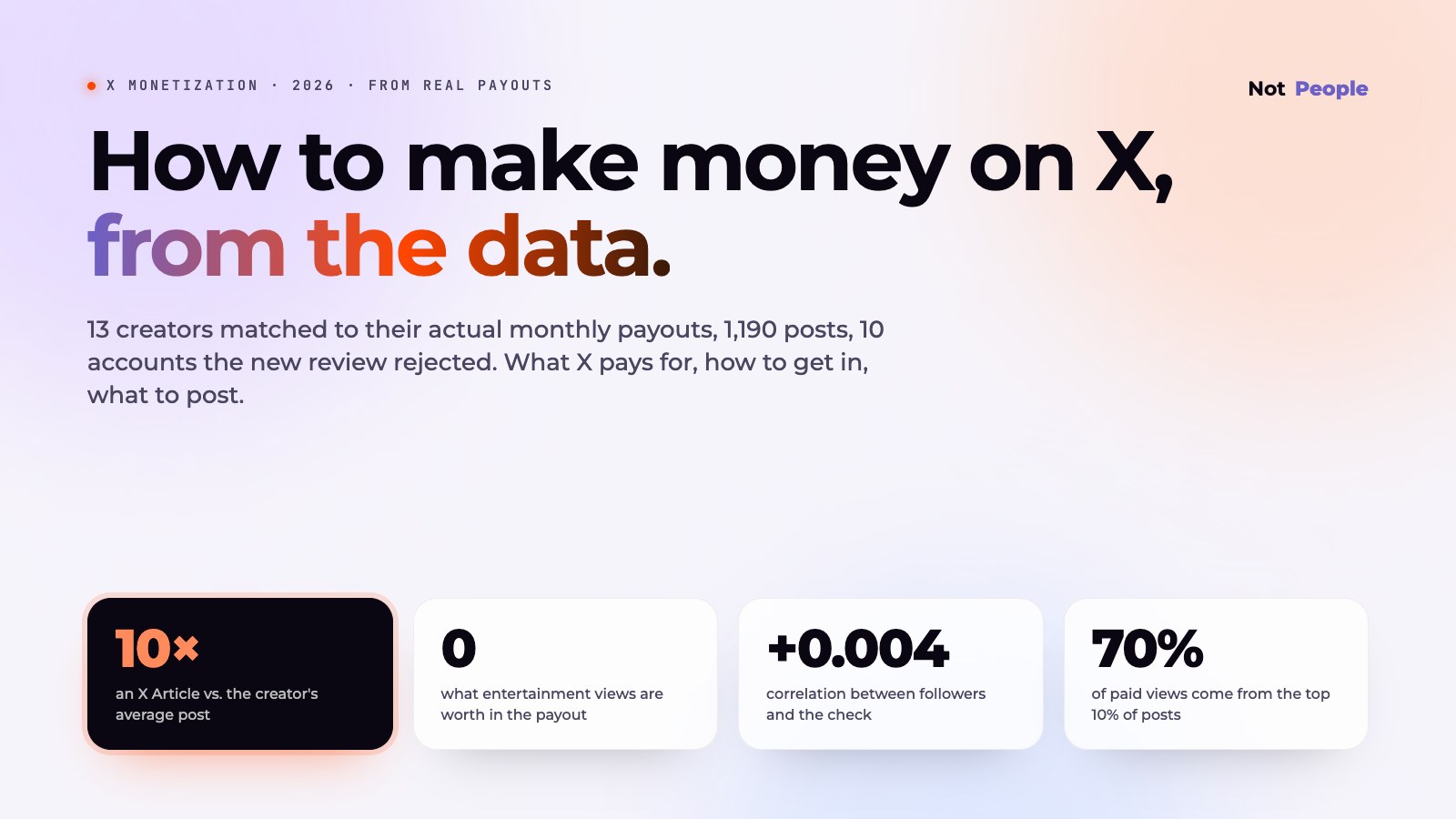
How do you make money on X in 2026? Through Original Content Rewards, the program that replaced Creator Revenue Sharing on September 7, 2026. You need X Premium, 500 verified followers, 500,000 impressions from verified users in 90 days, and you have to pass a human review of ten posts. Once you are in, the payout behaves like a meter: a roughly fixed rate per view in a topic advertisers pay for. We matched 13 creators to their real monthly payouts and that one number predicted the check almost exactly. Entertainment views are worth close to nothing. Followers and likes do not predict the money at all. The single most valuable thing you can publish is an X Article: about 10× the views of a regular post for the same creator. Below: how the meter works, how to pass the review, what to post, and the first six weeks as a plan.
An account with 8.6 million views landed near the bottom of the payout table
One creator in our sample pulled 8.6 million views in a month. Ninety-three percent of those views were entertainment: a game leak and a movie meme. X paid for the other seven percent, and the account finished near the bottom of the table.
If you are starting an X account and want it to pay, that one fact saves you a year. Views in a topic advertisers buy are money. Views in a topic they don't are a number on a screen.
This guide is built on data. Through Celebex, the creator marketplace NotPeople operates, we pulled 30 creator accounts in AI, crypto and tech, took 16 apart post by post, and matched 13 of them to the actual monthly payout each creator received in August 2026. That is 1,190 posts, 79 long-form Articles, one calendar month. On top of that we read the feeds of ten accounts the new payout review rejected, to see what the reviewer is looking for.
Names, handles and dollar amounts are stripped. Accounts are coded A1 to A13 for the main sample and K1 to K3 for a cluster we look at separately.
It goes in the order you will need it: how the money works, how to get in, what to post, how to grow, and what to skip.
Step 1. Understand what X actually pays for
Before you write a single post, understand the meter.
We took the 13 accounts with known payouts and tested which number predicts the money best: all views, views in paid topics only, the best Article of the month, the sum of all Articles, followers, likes, post count.
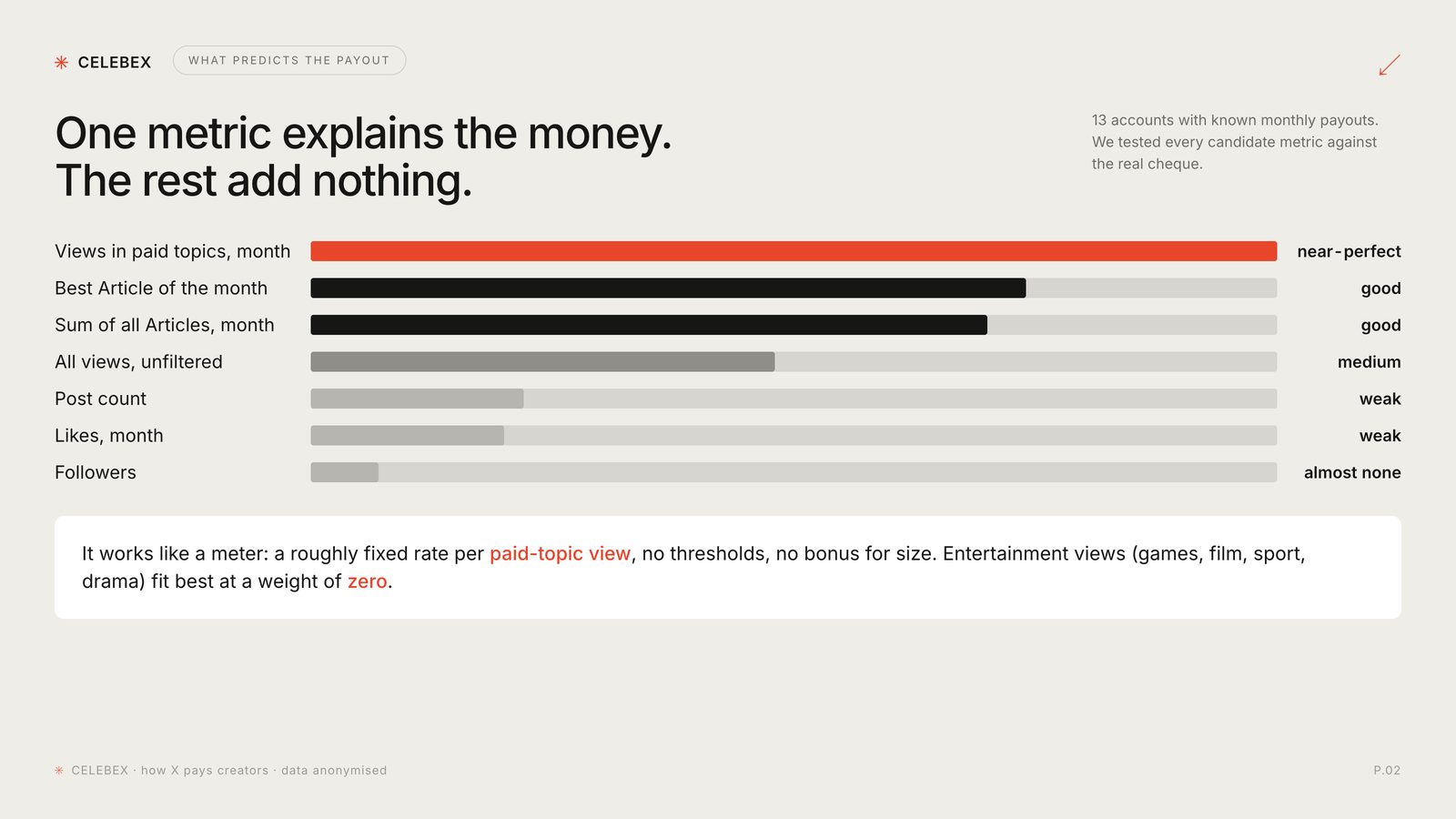 One metric explains the money. The rest add nothing.
The simplest metric won. Take the month's views, throw out anything entertainment (games, film, sport, drama, viral news), count the rest. That number predicts the payout almost exactly (rank correlation 0.978). Remove any single account from the sample and the ranking does not move.
It behaves like a meter: a roughly fixed rate per paid view, no thresholds once you are in, no bonus for being big. Double your views in the right topics and you roughly double the check. Nobody in the sample got zero. The gap is volume.
Entertainment views are worth nothing here. We tried giving them partial credit in the model, and the fit was best at a weight of exactly zero.
Why: your cut is a share of the ad money around your topic. Advertisers pay a lot for AI, automation, finance and useful tools. Games and film are the cheapest inventory on the platform. A million views about a game and a million views about an AI tool are different money.
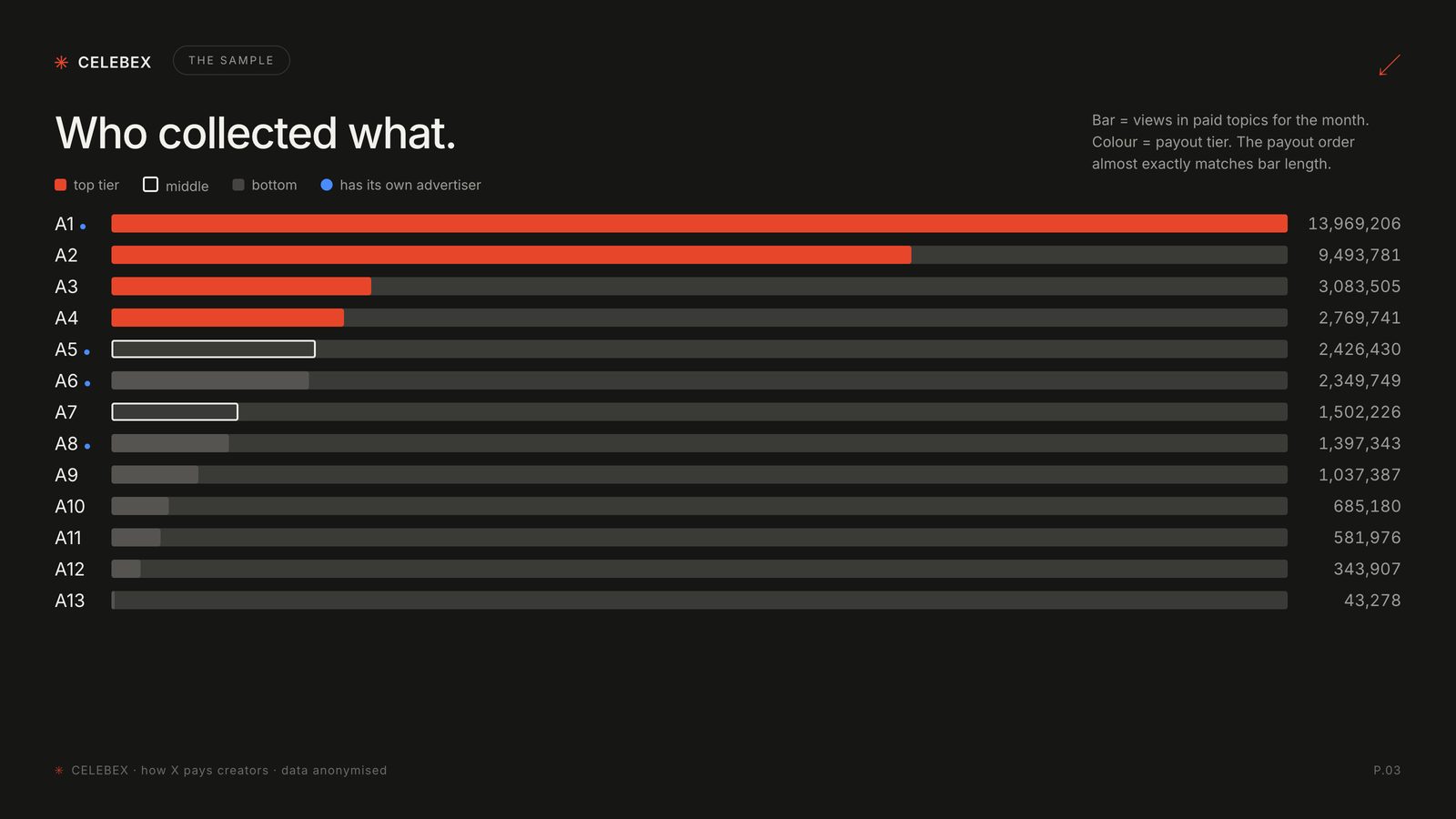 Who collected what. A1 leads on paid views; A11 leads on raw views and sits near the bottom.
What this means for a beginner: pick your topic by where the ad money is, not by what is easiest to go viral with. The account at the top of that chart (A1) and the account with the most raw views (A11, the 8.6M one) are different accounts.
Two more things the data settles before you start:
- Followers don't predict the money. Correlation with the payout, after views are accounted for: +0.004. An account with 5,600 followers out-earned one with 23,500. Buying followers "for monetization" does nothing.
- Likes and engagement rate don't either. They are weak predictors at best, and mildly inverse: the best like-to-view ratio in the sample earned the least.
Step 2. Get into the program: the X monetization requirements
This is the part most guides skip. Under the X rules from August 7, 2026, payout eligibility has two arithmetic thresholds and one human filter:
- An active X Premium subscription. Basic does not qualify; we compared the tiers in Is X Premium worth it.
- 500 verified followers.
- 500,000 impressions from verified users in the last 90 days.
- A reviewer reads ten of your posts.
Most people pass the numbers and fail the review. We read the feeds of ten rejected accounts. All of them cleared the thresholds. The rejection happened at step four.
The timeline, for anyone who missed it: the old Creator Revenue Sharing program stopped accepting enrollments on August 7, 2026 and paid its last day on September 7; applications for Original Content Rewards opened the next day. In the application you pick the ten posts yourself, from a set the app shows you, and you attest that they are yours. Nikita Bier, who ran product at X until August, described it on a podcast this way: "It's not a college essay. It's a user attesting that they didn't steal content. It's a permanent record of an account's honesty, so we know if you're a scammer or not during appeals." So the ten are your best case, and your signature under it.
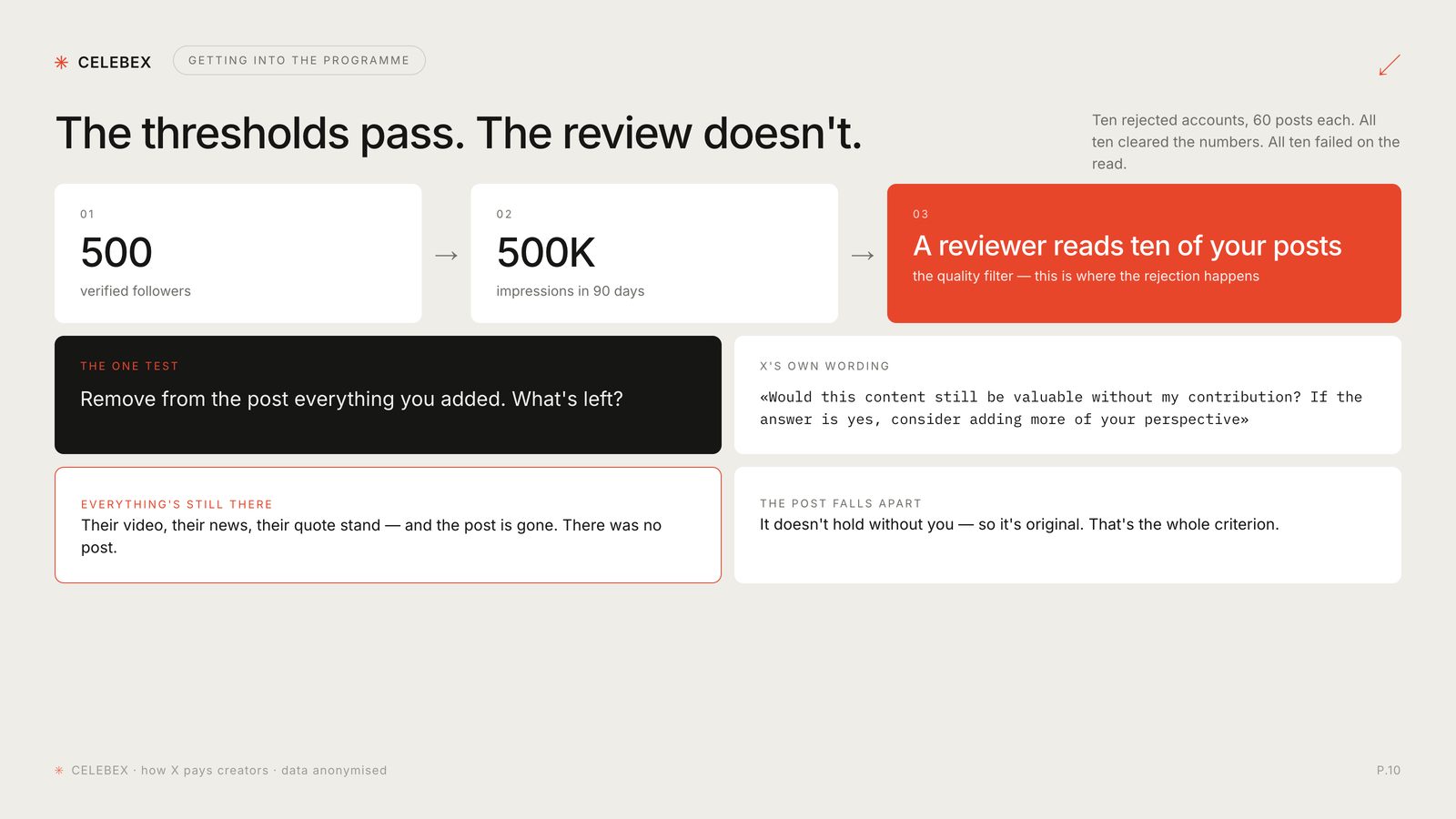 The thresholds are arithmetic. The rejection happens at the review.
X publishes what the reviewer checks against. Here is the list, with what each item catches in practice:
| X's wording | What it catches |
|---|
| copied or substantially reproduced from another creator | Someone else's text or idea, retold. An unnamed "insider at the lab wrote…" goes here. |
| downloaded from X or another platform and reuploaded | Someone else's clip, posted as yours. A conference clip, someone's demo. |
| created or posted using automated means | Generated by a model, or posted by a scheduler. Caught by text templates and timestamps. |
| exclusively focused on monetization coaching or maximizing payouts | "How to earn on X", "my payouts", "how to squeeze more views." |
| disinformation or misleading content | Invented sums and invented insiders: "$50 → $5,273 in 48 hours" with no source. |
| captions or text overlays that simply describe what is happening | The video shows a robot; the text says "the robot walks." |
| summaries that are purely descriptive | A press-release retelling: they launched X, it does Y, it costs Z. |
| reposting with attribution but without meaningful commentary | A quote-post with "via @author" and one line. Crediting is not adding. |
| reaction posts that add little to no value | "This is insane", "the important part here is…" without the part. |
| do not solicit engagements: like, reply, bookmark, follow, repost | "Bookmark this ↓", "save this", "reply and I'll send the setup." A listed violation, not a minor negative. |
Minor edits (cropping, filters, watermark, speed, a text overlay) are explicitly named as not counting as transformation.
All of that reduces to one test X states itself: "Would this content still be valuable without my contribution? If the answer is yes, consider adding more of your perspective."
So: remove from the post everything you added. What is left? If someone else's video, news or quote is still standing and the post is gone, there was no post. If it falls apart without you, it is original. That is the whole criterion.
What counts as yours, from X's own five categories: your text, thread, Article or breakdown; photos and video you shot (a screencast of your own terminal, your own demo); memes and graphics you produced (their data, your render, source credited); a reaction with a real perspective (their quote, your experience); a meaningful transformation of someone else's material (their clip plus your breakdown of why it matters to you).
Here is how the post types we found across those ten accounts fared against the list:
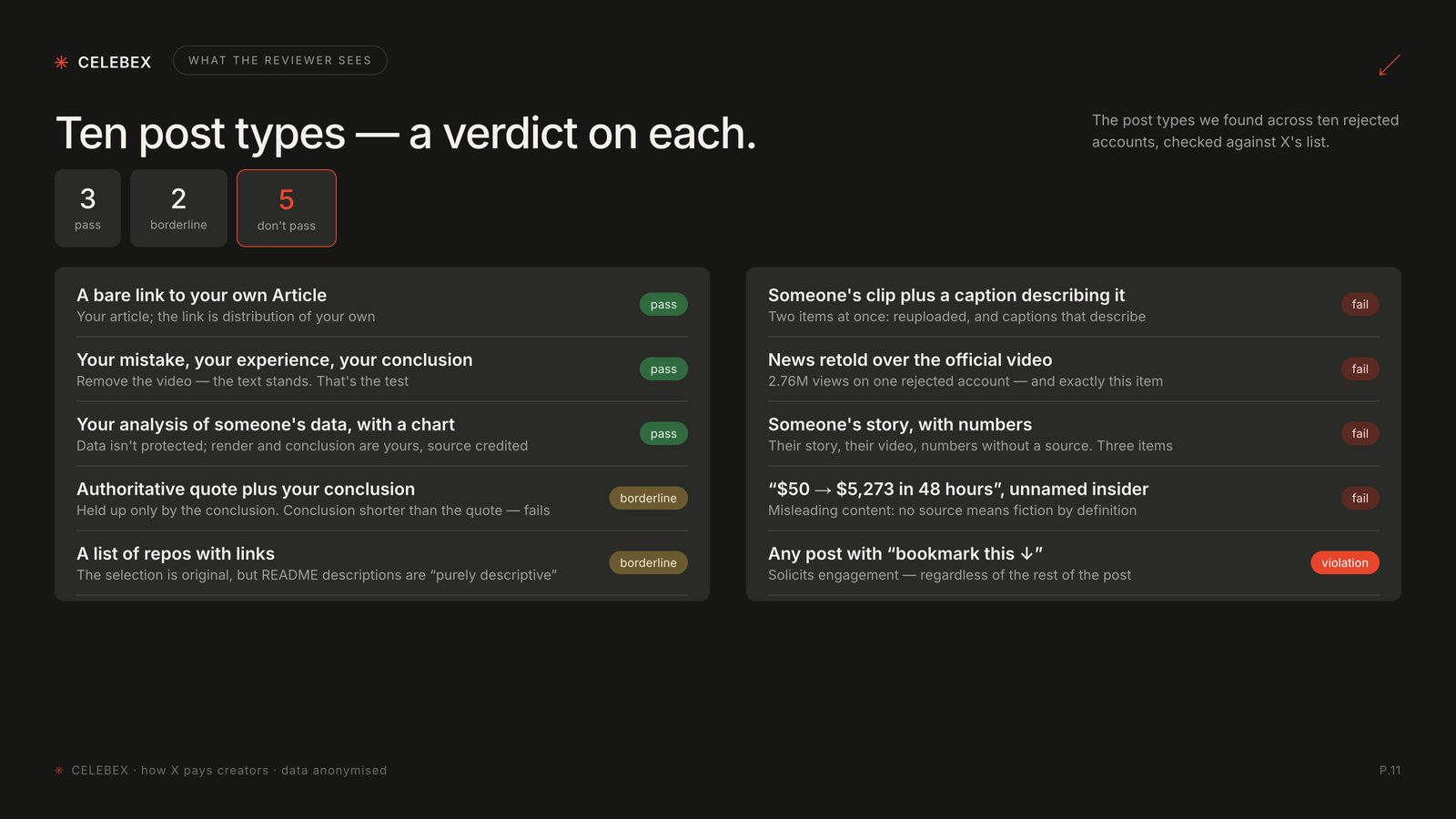 Three pass, two are borderline, five fail.
One more thing the reviewer sees before reading a word: automation leaves a trace in the timestamps. In the rejected accounts we saw 19 of 60 posts published at :00 or :01 seconds (a human lands on :00 about 2% of the time), one skeleton reused across nine daily slots, and the same call to action in 39 of 60 posts. Post by hand, at least the ten they will read.
A quick check you can run right now: open your last ten posts. For each one, mentally delete the media, the quote and the news. Count how many still have a sentence only you could have written. That number is your application.
Check your account's reach first
Step 3. Make the X Article your main product
Once you are in, the question is what to post. The data is not subtle.
Every post is measured against that creator's own average post (1.0×), so account size drops out.
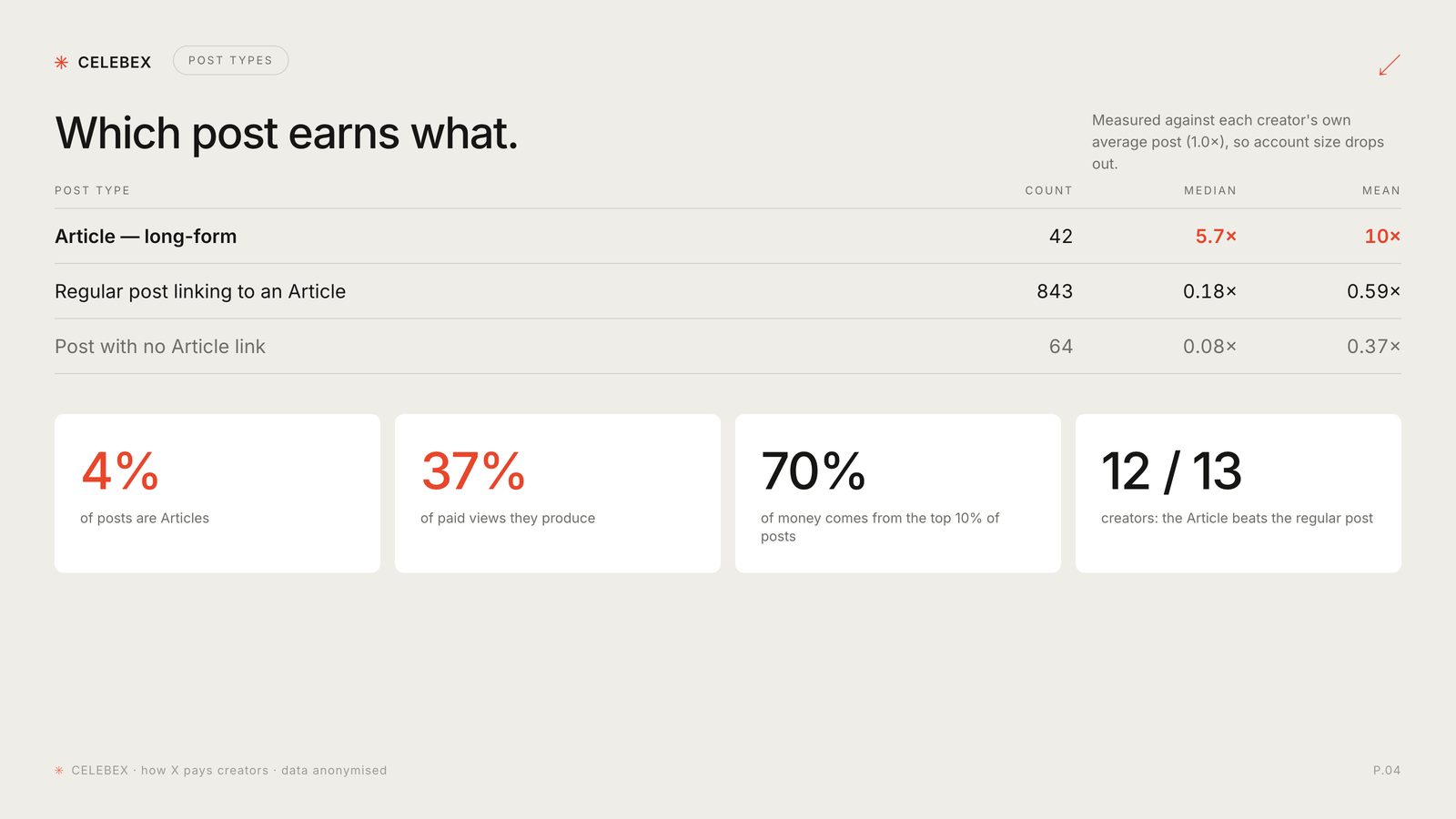 The Article is the product. Everything else is distribution.
| Post type | Count | Median | Mean |
|---|
| Article (long-form) | 42 | 5.7× | 10× |
| Regular post linking to an Article | 843 | 0.18× | 0.59× |
| Post with no Article link | 64 | 0.08× | 0.37× |
An Article averages about 10× a regular post. It beat the regular post for 12 of 13 creators. Articles were 4% of posts and produced 37% of the paid views. Inside one topic (the Article plus every post pointing at it), the Article itself takes 70% of the views, though it usually has 6 to 28 satellite posts around it.
Put plainly: all your ordinary posts together bring in half of what one Article does. So a beginner's plan is built around Articles rather than around a daily posting habit.
Two things that follow:
The money comes from a few hits. For most creators the top 10% of posts deliver 70% of paid views; the single best post of the month delivers 14% to 58%. Polishing your average post is close to pointless. A normal post with normal numbers is another ticket. You need more tickets and bigger wins.
Posting more doesn't dilute. The fear that "post more and each one gets less" did not show up. More posts per day meant more views per month, and the average reach per post held. The sample tops out at 4 posts a day with no sign of audience fatigue.
And the Article passes the review by design: it is your text. A bare link to your own Article was one of only three post types that cleanly passed in the rejected-accounts read.
Elon Musk said as much on the Lex Fridman podcast back in 2023: the algorithm is "totting up how many user seconds" people spend, so "it is actually better to do things that are long form on the system." Two years later, the payout data agrees with him.
Step 4. Feed each Article for six weeks
The most common beginner mistake is publishing an Article, posting about it twice, and moving on. Here is the full life of one Article: every satellite post pointing at it, by day since publication, across two accounts.
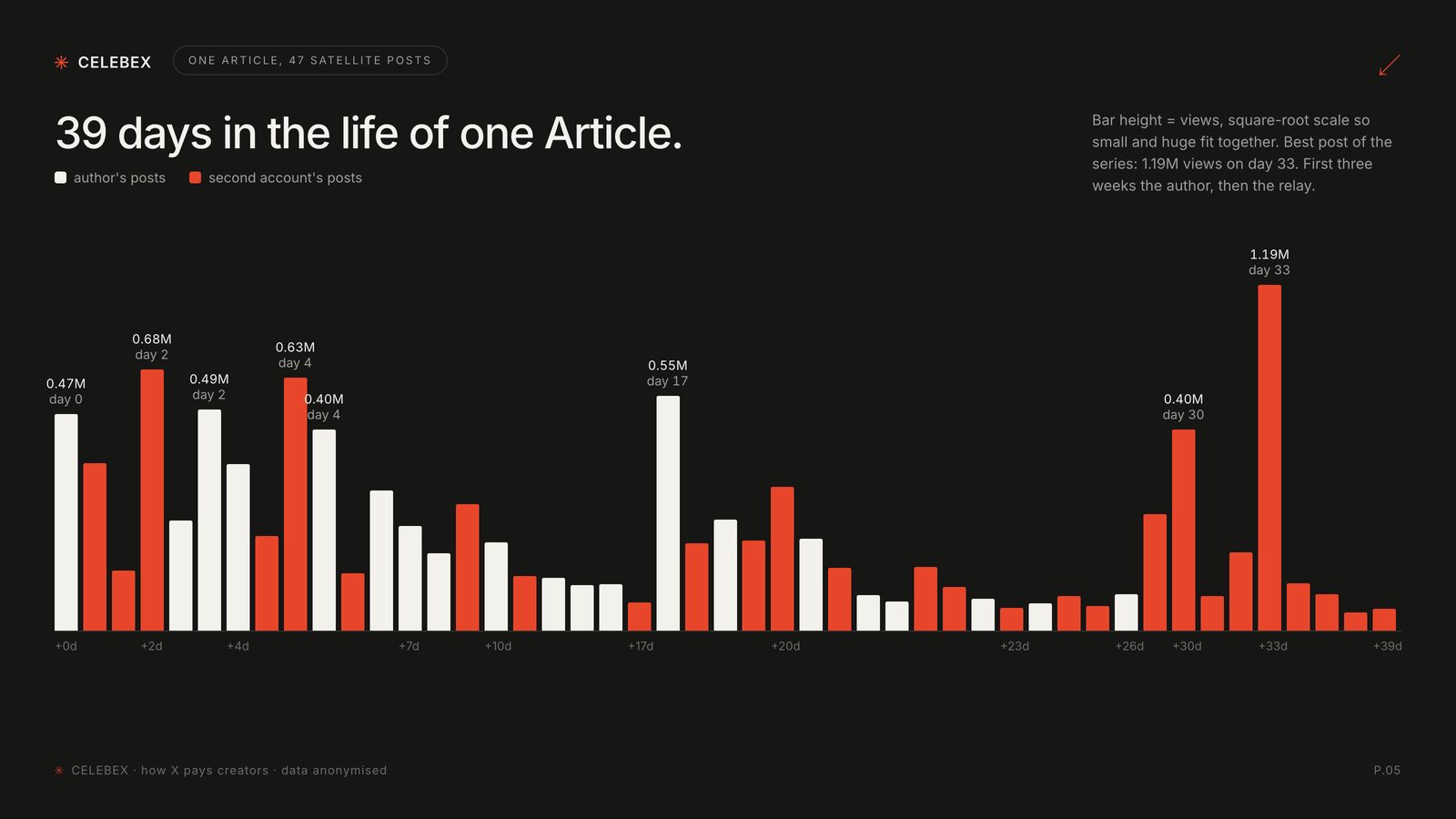 39 days of one Article. The best post in the series went out on day 33.
47 satellite posts over 39 days. The best post in the entire series, 1.19 million views, went out on day 33. There were big spikes on day 22 and day 30. That is a lottery that runs for over a month, with no decay curve in sight.
What changes is the framing. The same material, presented from a new angle, produces a new spike. The day-30 reframe is what produced the 1.19M post.
The whole sample shows the same thing. Satellite posts published two weeks or later after the Article average more views than ones published in the first 24 hours. Your first post about an Article is usually weaker than your fifth.
| When the satellite post goes out | Typical views |
|---|
| First 24 hours | 6,262 |
| Days 1 to 3 | 5,531 |
| Days 3 to 7 | 6,444 |
| Days 7 to 14 | 4,932 |
| Two weeks and later | 8,147 |
Plan 40 to 50 posts per Article over about six weeks. Change the angle every 5 to 8 posts. Don't dump everything in week one.
Step 5. Write posts that hold up
Two constraints at once: the post has to earn views, and it has to pass the reviewer. The good news is that the data on what earns views mostly agrees with what passes.
Techniques checked against the numbers, relative to the creator's own average post. "Works" held up in the data; "maybe" is a weaker signal; "hurts" is no effect or negative.
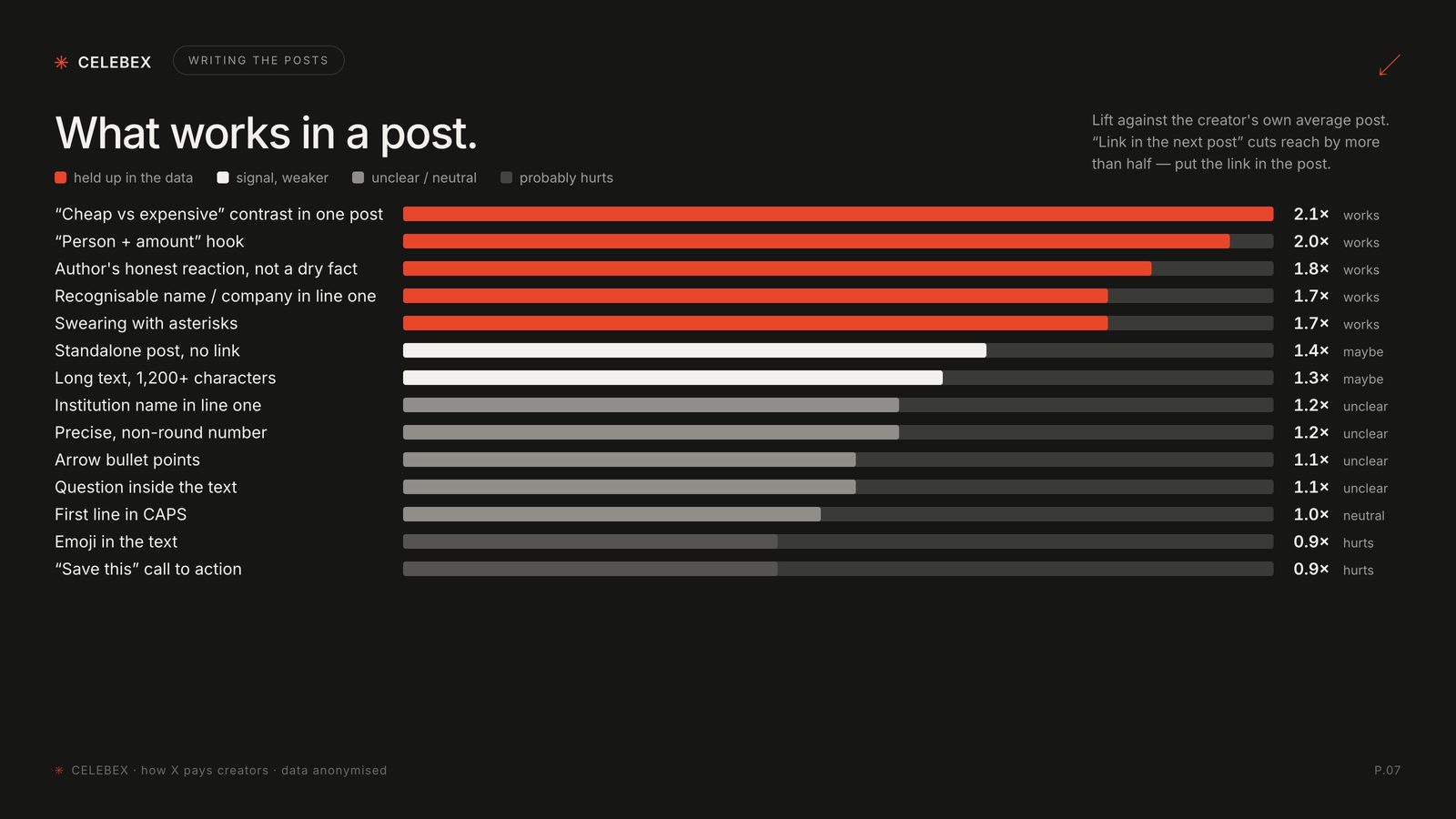 What works in a post, and what quietly hurts.
| Technique | Posts | Lift | Confidence |
|---|
| "Cheap vs expensive" contrast in one post | 25 | 2.1× | works |
| "Person + amount" hook: who, age, a small sum | 58 | 2.0× | works |
| The author's honest reaction instead of a dry fact | 78 | 1.8× | works |
| A recognizable name or company in the first line | 135 | 1.7× | works |
| Swearing with asterisks | 65 | 1.7× | works |
| Post with no link, standalone | 59 | 1.4× | maybe |
| Long text (over 1,200 characters) | 213 | 1.3× | maybe |
| Institution name in the first line | 92 | 1.2× | unclear |
| A precise, non-round number | 200 | 1.2× | unclear |
| Arrow bullet points | 284 | 1.1× | unclear |
| A question inside the text | 84 | 1.1× | unclear |
| First line in CAPS | 338 | 1.0× | neutral |
| Emoji in the text | 64 | 0.9× | probably hurts |
| "Save this" call to action | 384 | 0.9× | probably hurts |
Notice the third row: the author's honest reaction lifts a post 1.8×, and it is also exactly what the reviewer wants to see. The sentence only you could write ("I ran it", "mine broke here", "I think, and here's why") is both the growth technique and the pass condition.
Notice the last row too. "Save this" sits in 384 of 885 posts, mostly on autopilot. It slightly hurts reach, and under the new rules "bookmark this" is a listed violation regardless of what else the post says. Cut it.
One thing that hurts badly: "link in the next post" cuts reach by more than half. Put the link in the post. Bier explained why on the same podcast: X rebuilt link handling so that "link impressions go way up. Now writers could post links." The old reply-link trick is dead.
Topics and angles that work:
| Angle | Posts | Lift | Confidence |
|---|
| "This model replaces this specialist, and here's what it costs" | 27 | 2.1× | works |
| Auto-trading / a bot with a verifiable result | 75 | 1.7× | works |
| Generative video and creative tools | 58 | 1.3× | maybe |
| Paper and benchmark breakdowns | 101 | 1.1× | unclear |
| How a regular person made money | 70 | 1.1× | unclear |
| Institutions and funds | 145 | 1.1× | unclear |
| "Look, I have an AI agent" | 364 | 1.0× | worn out |
| Limits, failures, "AI is dangerous" | 133 | 0.9× | probably hurts |
The most common angle in the sample, "I have an AI agent and it does my work" (364 posts, all 13 creators), lands exactly at average. It is furniture now. What still works on top of it: name which specialist the tool replaces and what it costs, or show a result someone can check.
Two skeletons to start from
Structure from the best-performing posts. Brackets are what you fill in.
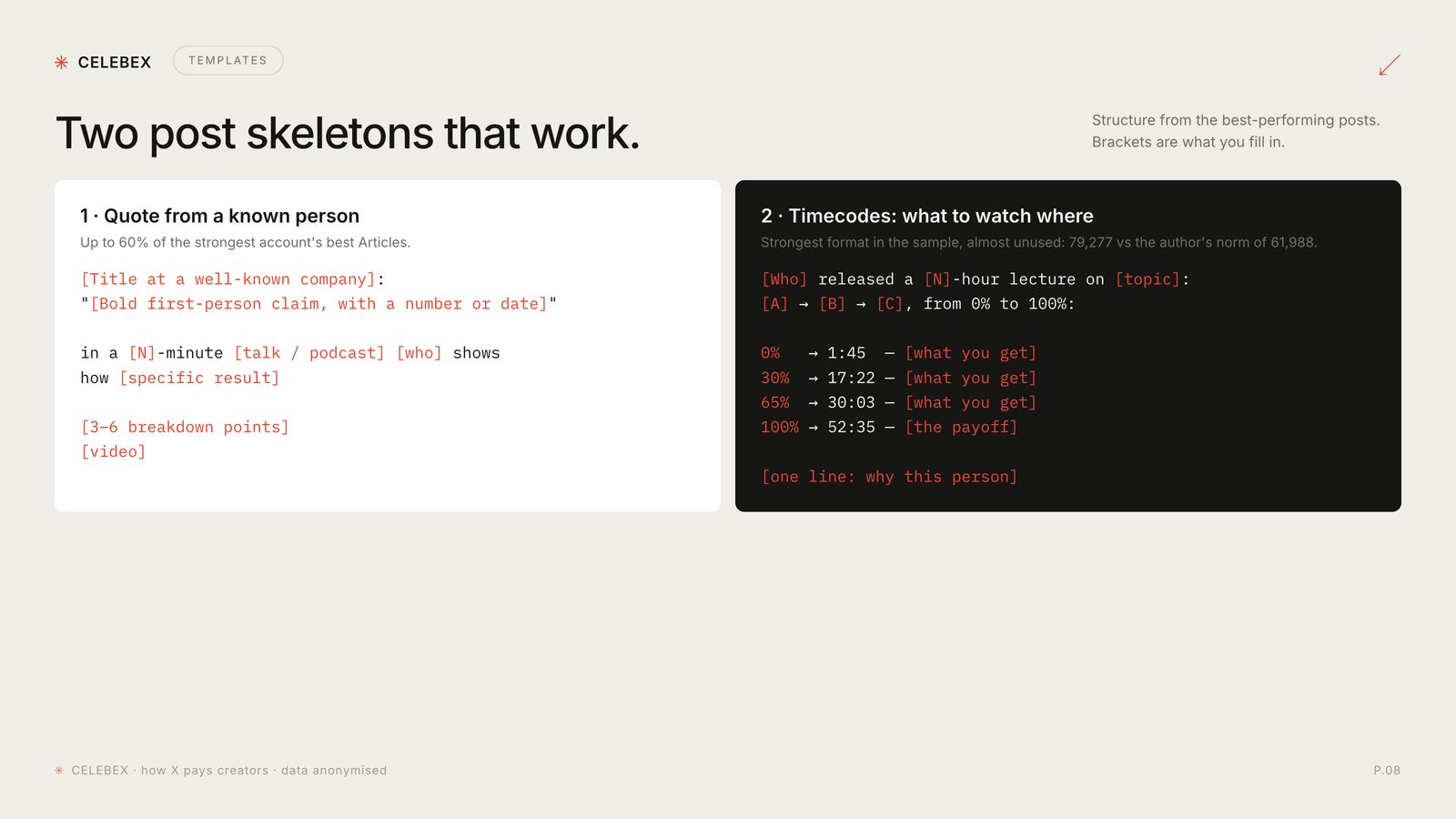 The two skeletons behind most of the strongest posts.
Skeleton 1 · Quote from a known person. Up to 60% of the strongest account's best posts use it.
[Title at a well-known company]:
"[Bold first-person claim, with a number or a date]"

in a [N]-minute [talk / podcast] [who] shows how [specific result]

[3–6 breakdown points]
[video]
A warning that comes straight from the review list: this skeleton only passes if what is under the quote is yours. In the rejected accounts, "authoritative quote plus my one-line conclusion" was borderline, and it failed whenever the conclusion was shorter than the quote. Make the quote the occasion rather than the content: "I spent a month proving him right without meaning to; here's what broke."
Skeleton 2 · Timecodes: what to watch where. The strongest format in the sample, and almost nobody uses it: 79,277 views against the author's own norm of 61,988.
[Who] released a [N]-hour lecture on [topic]:
[A] → [B] → [C], from 0% to 100%:

0%  → 1:45  — [what you get]
30% → 17:22 — [what you get]
65% → 30:03 — [what you get]
100% → 52:35 — [the payoff]

[one line: why this person]
It works because it does the reader a favor: a long video laid out by timecode, so you see where you are and what you will have by the end. It is also your work, not the video's. For a beginner it is the best first format: no audience needed, no hot take needed, just a long talk in your topic and an hour of your time.
If you want the drafting and the trend-hunting done for you while you keep the account and the approvals, that is what the NotPeople MCP does from Claude Code: it reads what is moving in your niche, drafts in your voice, and posts from a browser on your own machine.
Step 6. Post at the right time, with media
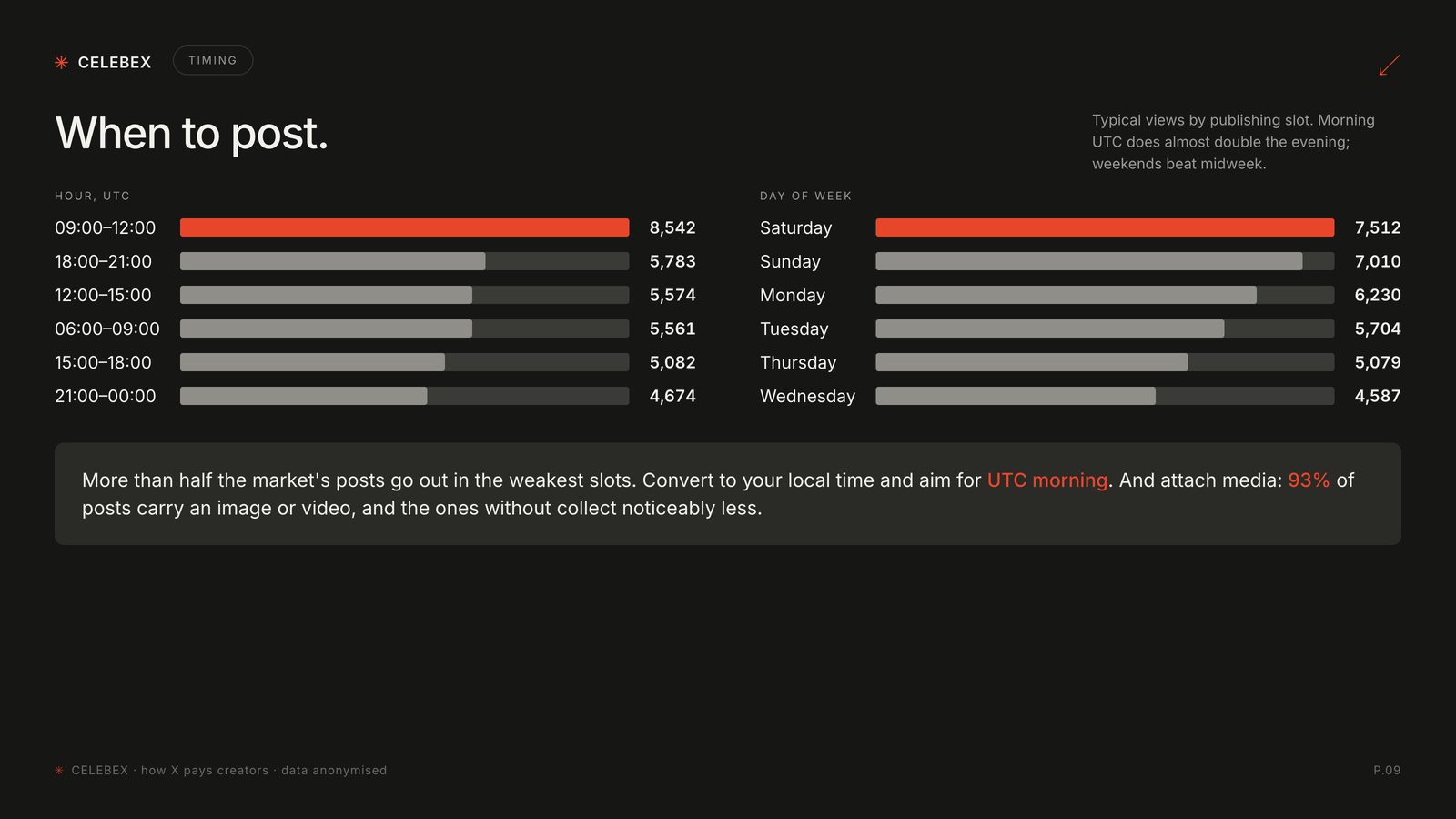 Morning UTC does almost double the evening. Weekends beat Wednesday.
| Hour (UTC) | Typical views | | Day | Typical views |
|---|
| 09:00 to 12:00 | 8,542 | | Saturday | 7,512 |
| 18:00 to 21:00 | 5,783 | | Sunday | 7,010 |
| 12:00 to 15:00 | 5,574 | | Monday | 6,230 |
| 06:00 to 09:00 | 5,561 | | Tuesday | 5,704 |
| 15:00 to 18:00 | 5,082 | | Thursday | 5,079 |
| 21:00 to 00:00 | 4,674 | | Wednesday | 4,587 |
More than half the market's posts go out in the weakest slots. Convert to your local time and aim for UTC morning.
Attach an image or video almost every time: 93% of posts carry media, and the ones without collect noticeably less. Your own screenshot, your own chart, your own screencast: that is both the media and the originality.
Step 7. If you're not alone, split the roles
Everyone knows the scheme: write an Article, then quote it for weeks, with your own posts and your friends' posts. X counts the view even when it lands on someone else's material.
The question is why the same scheme gets one creator 5,000 views a post and another 60,000. We took apart a cluster of three accounts around one shared community.
| Account | Followers | Total posts | Typical Article | Posts/day |
|---|
| K1 · the factory | 40,819 | 1,313 | 46,929 | 1.2 |
| K2 · the independent | 16,014 | 1,037 | 61,988 | 0.9 |
| K3 · the pusher | 34,418 | 12,854 | 16,143 | 0.8 |
| A1 · best of the regular sample | 29,414 | 12,329 | ~11,900 | 2.0 |
| Regular sample, typical creator | | | 5,357 | 2 to 4 |
K2's typical Article draws 61,988 views against 5,357 for a typical creator: almost 12×, on half the posts per day.
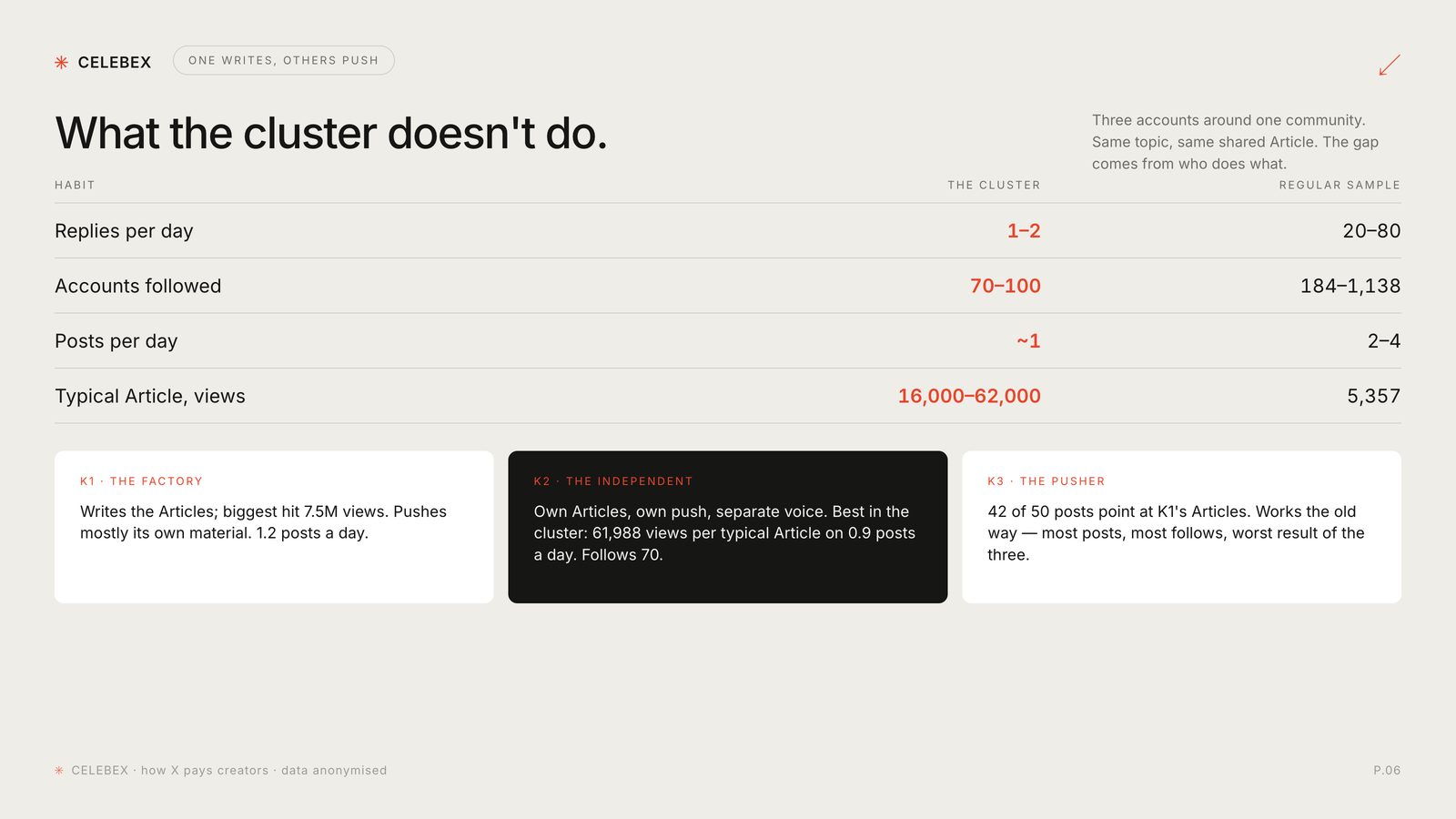 What the cluster refuses to do.
| Habit | The cluster | Regular sample |
|---|
| Replies per day | 1 to 2 | 20 to 80 |
| Accounts followed | 70 to 100 | 184 to 1,138 |
| Posts per day | ~1 | 2 to 4 |
| Typical Article | 16,000 to 62,000 | 5,357 |
The roles are split: K1 writes the Articles, K3 pushes them (42 of its 50 posts point at K1's work), K2 writes and pushes its own. And the cluster has its own control group: K3 also posts the most, follows the most and lives in the replies, and it has the worst numbers of the three, a quarter of K2's. Same community, same topic, same shared Article. The old approach gets a fraction of the result.
"Post more" and "post less" both appear in this guide. They answer different questions. Volume has no downside: an extra post almost always pays for itself. The multiple comes from structure. If you are alone, write more. If there are two or three of you, don't make everyone write an Article and grind four posts a day. One writes, the others push.
This is the mechanic behind creator circles in the NotPeople creator network: creators in the same paid topics who push each other's Articles from their own accounts, the way K1 and K3 do, plus brand campaigns once your numbers are there.
Step 8. What to skip
Things the data says earn nothing, or that the review now punishes:
- Replies for the sake of replies. 20 to 80 answers a day, 30 to 90 views each, no effect on payout. The cluster answers 1 to 2 times a day. (Replies do work for growth in a different way; we covered that in reply-led X growth. They just do not show up in the check.)
- Follow-for-follow. No effect on money. The cluster follows 70 to 100 accounts.
- Buying followers. No link to payout; mid-table money is reachable with 5,000 followers.
- "Save this", "bookmark this", "reply and I'll send it." Slightly hurts reach, and it is a listed violation.
- Invented numbers and anonymous insiders. In the cluster we took apart, the same claim was posted 15 times in 19 days with the key figure swapped between 70%, 80% and 90%, attributed to unnamed "employees at well-known companies." The reach came from the post's skeleton rather than the figure. Under the new rules that is "disinformation or misleading content": without a source, it is fiction by definition.
- Someone else's clip with a caption describing the clip. Two violations at once (reuploaded, and captions that describe). One rejected account had a 2.76M-view post that was exactly this: every sentence from the lab's own announcement.
- Posting about how to earn on X. Fails by definition.
- A scheduler. It leaves a trace in the seconds.
- Betting everything on one product. Some accounts had up to 95% of reach tied to one thing. A10 had a 7M-view Article one month and 54K the next.
Step 9. Your first six weeks
Everything above, as a plan. The numbers are the sample's, not targets we invented.
Before you post. Pick a paid topic (AI tools, automation, finance, dev tools) and one angle inside it you can speak to from your own use. Decide how you will produce your own media: screenshots, a chart from public data with the source credited, a screencast. Check the account is actually being shown to people before you build on it; a throttled account wastes six weeks. The shadowban checker takes thirty seconds.
Week 1. Write your first Article. Don't wait for followers; the Article is what you will point at. Publish it and 5 to 7 satellite posts in the first week, at least one in the timecode format. Post in UTC morning, by hand.
Weeks 2 to 3. Keep feeding Article one: a new angle every 5 to 8 posts. Start Article two around day 7 to 10 (one every 7 to 10 days is the minimum rhythm the data supports; the cluster holds about one a week). One to four posts a day, all with media, none with "save this."
Weeks 4 to 6. Article one is still alive; the sample's best satellite post came on day 33. Reframe it. By now you have two or three Articles to rotate between, which is the volume the model rewards. If there is a second person, hand them the pushing.
When you hit the thresholds. Look at your last ten posts the way the reviewer will: remove the media, remove the quote, remove the news. Is there a sentence in each one only you could have written? If yes, apply. If no, replace those posts first.
Apply to the creator network
What we can't promise
The model explains most of the difference in payouts but not all of it. Some creators earn one and a half to two times more or less than their views say they should, and none of the things we could measure (share of own Articles, topic narrowness, share of video, text length, engagement, post count, audience size) closes the gap. Most likely it is what we don't have: where the audience is located and which ad category the creator was assigned to.
We also can't tell you in advance which Article will hit a million. Plan a system and a number of attempts, not a specific hit.
Limits. 30 accounts collected, 16 examined in detail, 10 rejected accounts read; that is still small, and creator-level conclusions are premature. The split between paid and unpaid topics is our own and should be re-checked on new data. Rows with few posts are a prompt to test, not a rule. Payout figures came from the participants, not from platform reports. X does not publish its review method; the reading of the list is ours.
How the data was anonymized. Accounts are coded: A1 to A13 is the regular sample in descending order of paid views, K1 to K3 is the cluster by role. Names, links and handles are removed. Post wording is given as generalized skeletons, never verbatim, so the source can't be found by search. Payout amounts are not in this piece; only derived values (rank, tier, ratios).
FAQ
What does X pay per 1,000 views? X does not publish a rate, and we can't publish the one we derived without exposing the participants. What the data shows is the shape: the payout scaled linearly with views in advertiser-friendly topics, with no threshold and no bonus for size. The same 1,000 views are worth many times more in AI, finance or dev tools than in games, film or sport, so the honest per-1,000 answer is "it depends on the topic more than on anything else."
How many followers do you need on X to make money? 500 verified followers to apply. Beyond that, followers did not predict the payout in our sample (correlation +0.004). An account with 5,600 followers out-earned one with 23,500 because its views landed in paid topics.
Can you make money on X just by posting? Yes, if the posts are yours and the topic is one advertisers buy. The review reads ten of your posts before you are admitted, so posts that are reuploads, descriptive captions or "bookmark this" calls to action will keep you out regardless of views.
What are the X monetization requirements in 2026? An active X Premium subscription, 500 verified followers, 500,000 impressions from verified users in the last 90 days, and passing a human review of ten posts against X's Original Content Rewards list. The review is where most rejections happen.
Why was my X monetization application rejected? In the ten rejected feeds we read, every account had cleared the numbers. What they shared: posts built on someone else's clip or announcement with nothing added, "bookmark this" calls to action, invented figures without a source, and timestamps that showed a scheduler. Fix the last ten posts before you reapply.
Do X Articles pay more than regular posts? In our sample an Article averaged about 10× the views of the same creator's regular post and beat it for 12 of 13 creators. Articles were 4% of posts and produced 37% of the paid views. X pays per qualifying view, so more views means more money, and the Article is the most reliable way to get them.
Does X Premium+ pay more than Premium? No. Both tiers are eligible for Original Content Rewards on the same terms. Premium+ adds Grok, an ad-free feed and the ability to publish Articles, which matters for the strategy above; the payout rate is the same.
Data for steps 1 and 3 to 7: an open export for one accounting month, August 2026; 30 accounts collected, 16 examined in detail; 1,190 posts, 79 Articles; payouts supplied by 13 participants. Step 2 and the review-related parts of step 8: the last 60 posts of each of 10 rejected accounts, snapshot of September 13, 2026, read against the X rules of August 7, 2026. Collected through Celebex, the creator marketplace operated by NotPeople.