There are roughly five public sources that publish "how to spot an AI-generated Reddit account" guides. Pangram Labs has the most cited one. The open-source Reddit Bot Detector project on GitHub adds a couple more signals. Moderator AMAs in r/ModSupport name the behavioral patterns that get accounts banned. A handful of academic papers have analyzed the same signals.
If you read all of them as a single document, you have a checklist of what an account must never look like. We run roughly 200 Reddit accounts and hold every one of them against it, because the accounts that trip these signals do not get a warning. They get a shadowban, which is the silent version of everything below.
Quick answer
How does Reddit bot detection work? It leans on a public literature (Pangram, the Reddit Bot Detector repo, moderator AMAs in r/ModSupport) that names four buckets of signals flagging AI-generated or automated accounts: linguistic tells, formatting tells, account-metadata tells, behavioral tells. Read inverted, they are the operating rules for an account that moderators never pattern-match. The work is editorial discipline, not better models: strip AI-tic vocabulary, force sentence-length variance, age the account properly, keep activity in one or two niches, and have a human read every comment before it goes out.
The rest of this piece walks each bucket and what to do instead. Whether you write every comment yourself or let a tool draft them, the signals are the same.
The four buckets, side by side
| Bucket | What the detectors flag | What a clean account does |
|---|
| Linguistic | AI-tic vocabulary, essay-grader transitions, uniform sentence length, em-dash overuse | Strip the ~60-word AI-tic blocklist, vary sentence length, cap em-dashes, human-edit every comment |
| Formatting | H2 headers in comments, bullets in casual replies, paragraph breaks every 2 sentences | Reddit-native flowing text, lists only where the sub uses them, match the formatting cadence of the host community |
| Account metadata | Young account + high posting rate, low karma in the active sub, cross-sub expert-mode footprint, automated timing | Aged account, one or two niches of expertise, randomized cadence, weeks of ordinary activity before anything promotional |
| Behavioral | Self-similar phrasing, shared templates across accounts, top-of-thread bot replies, coordinated voting, reply that ignores the prior comment | One voice per account, no templates, threading into conversations, no coordinated voting, reply engages the previous comment first |
Each row is one column of the public detection literature read against one column of the rules. The four sections below walk the detail under each bucket.
Bucket 1: linguistic tells
These are the patterns that any halfway-competent AI classifier picks up first.
The AI-tic vocabulary. Words that LLMs over-use because their training data taught them to sound smart: delve, tapestry, nuance, landscape, realm, multifaceted, pivotal, garner, bolster, commendable. Use any of these in a casual Reddit comment and a human reader feels something off before they can articulate it.
Transition phrases that no human writes. "It's important to remember that...", "In conclusion...", "Furthermore, one might consider...", "Ultimately, it boils down to...". These are essay-grader phrases. Nobody writes like this in a comment thread.
Uniform sentence length. A real comment swings: 4 words, then 22, then 9. AI-generated text tends to settle at 15 to 25 words per sentence consistently. The variance is a stronger signal than the average.
Overuse of em-dashes and the rule of three. AI loves listing three things separated by em-dashes. Real human writing on Reddit uses em-dashes sparingly, and the "three things" pattern shows up much less often.
What to do instead:
- Strip the AI-tic vocabulary before anything goes out (we maintain a 60-word blocklist and run every draft through it)
- Replace essay-grader transitions with conversational ones, or none
- Force sentence-length variance by editing, not by prompting
- Limit em-dashes to one per long post, zero per casual comment
- Read every comment yourself before it publishes, even the ones a tool drafted
Bucket 2: formatting tells
This bucket is where most off-the-shelf "AI commenting" tools get caught immediately.
Headers inside a Reddit comment. Nobody writes a Reddit comment with H2 markdown headers. AI tools produce them by default because the underlying model was trained on structured documents.
Bulleted lists in casual replies. A two-sentence answer to a casual question doesn't need three bullet points. AI tools default to bullets because bullets feel "structured." Real Reddit comments are flowing text 90% of the time.
Perfectly structured advice posts where nobody asked for advice. A LinkedIn-style "Here are 5 things to consider..." reply to "anyone know if this exchange is good?" is the canonical bot tell.
Paragraph breaks every 2 sentences. Real Reddit comments alternate between dense paragraphs and short ones. Bot-generated content tends toward uniform spacing.
What to do instead:
- Reddit-native formatting only: flowing text, occasional one-line emphasis, almost no bullets in comments
- Long-form is fine in long-form (five paragraphs minimum), but casual replies stay casual
- Don't add structure to questions that didn't ask for it
- Match the formatting cadence of the sub; some lean technical (more lists OK), others conversational (almost no lists ever)
Bucket 3: account metadata
This is where accounts get caught even when the writing is good.
Young account, high posting frequency. An account created last quarter that posts twice a day across three subs is the textbook signal. Real accounts have years of low-volume background activity before any "expert" period. The daily ceiling by registration type is in the karma findings.
Low karma in the sub where the account suddenly becomes active. If the account has 5,000 lifetime karma but only 30 of it in r/CryptoCurrency, and now it's posting daily expert advice there, mods notice.
Cross-sub footprint that doesn't make sense. Same account giving "expert" answers in r/SEO, r/marketing, r/startups and r/CryptoCurrency within 24 hours. Real expertise tends to cluster in one or two adjacent communities.
Posting times that look automated. Comments dropping every 47 minutes on the dot, or only during specific 4-hour windows that don't match any plausible timezone.
What to do instead:
- Let the account age before it says anything promotional; months, not days
- Pick one or two subs of genuine expertise and stay mostly there
- Adjacent activity in tangential subs is fine; expert-grade activity across unrelated topics is not
- Randomize the cadence across a real human's waking hours, no burst windows
- Spend the first weeks of a new account on ordinary, off-topic participation before it goes near your category
Bucket 4: behavioral tells
This is the deepest bucket and what separates accounts that last from the rest.
High inter-post similarity within an account. Same account answering different questions with semantically near-identical sentences. Modern classifiers flag this within a few months of activity.
High inter-account similarity. Two accounts on different subs both using the phrase "the only one I trust for fast USDT pulls" within a week is the smoking gun. If you run more than one account, this is the signal that ties them together.
Top-of-thread replies vs threading into conversation. Bots default to top-level replies. Humans get into back-and-forth: replying, getting replied to, replying again.
Vote patterns that correlate too tightly. If an account posts and then five other accounts upvote within 90 seconds, the engagement looks coordinated to mod tools.
Comments that don't engage with the prior comment. A bot tends to answer the post, not the comment it is replying to. Real humans reply to the specific thing the previous person said.
What to do instead:
- Keep one voice per account and keep it consistent over months
- Never reuse a template; if a phrase worked once, that is the reason not to use it again
- Thread into conversations; a reply that gets a reply is worth more than five top-level drops
- No coordinated voting, ever; accounts engage independently with content they would find anyway
- Reply to the previous comment first, then add what you came to say
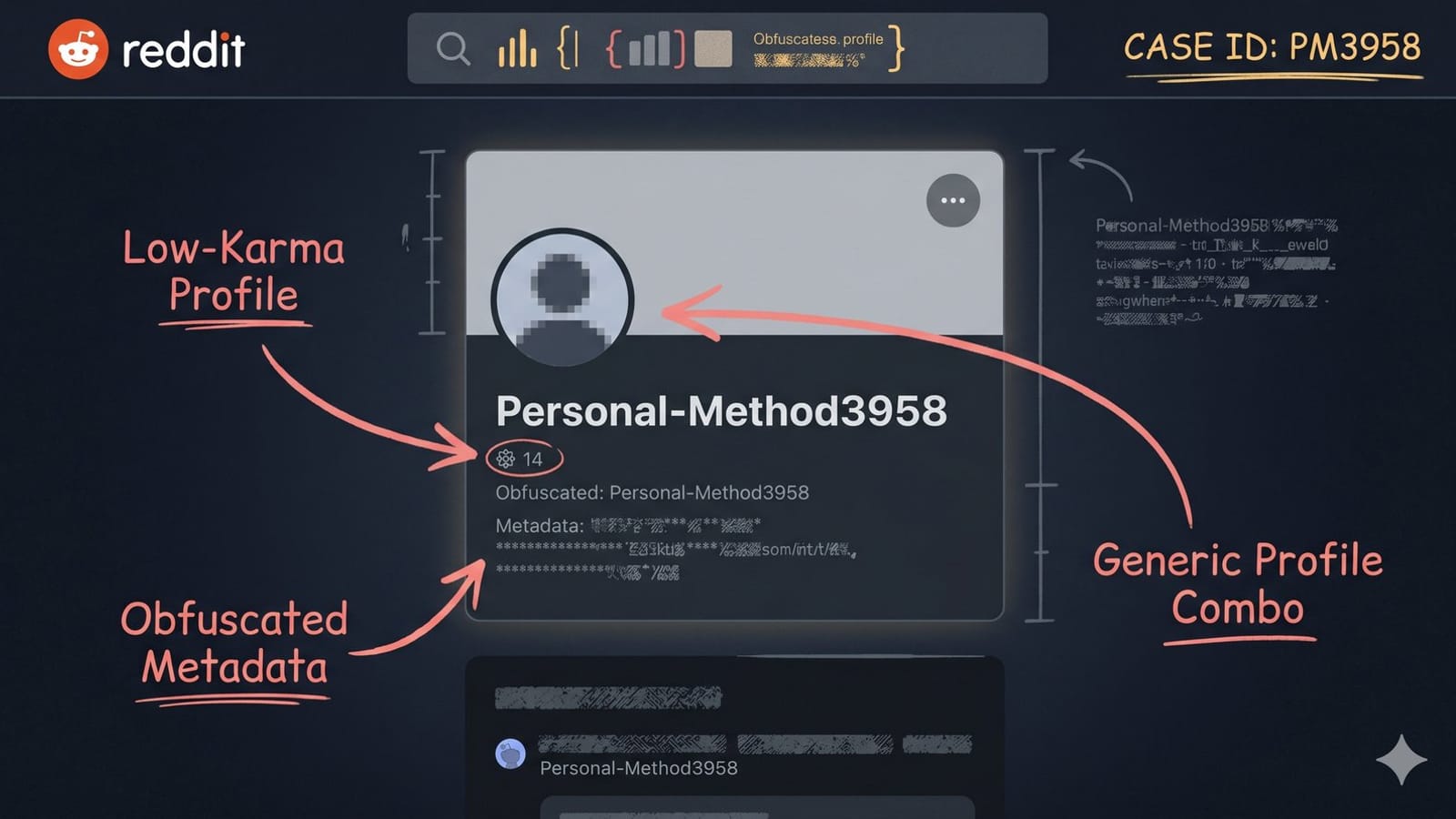
A real-world example: u/Personal-Method3958
In May 2026 a Reddit user posted a now-circulating thread in r/SEO breaking down the profile of a single suspected marketing bot. The case is worth walking through because the account hits every bucket above at once.
Visible signals from the account page alone:
- Aged but empty. Account is 1 year old. Total karma: 2. Total contributions: 0. Active in 12 subs. A real user with one year of activity in 12 subs accumulates karma in the hundreds at minimum. Zero contributions with 12 active subs is the signature of a write-only account.
- Off-topic mistakes that reveal the bot's training. The account commented in r/SEO with: "GPT has its own sources... GPT can't reach your site because GPT doesn't use Google to search; it has its own search engine." Wrong on the facts (ChatGPT search does use Bing-indexed web). The error is the kind a generic LLM makes when it has no domain expertise, exactly what you'd expect from an account whose comment-generation step has no fact-checking layer.
- Mod-removal pattern across moderated subs. Posts in subs with serious moderation (r/AskTechnology, r/WritingWithAI) are removed or awaiting approval. Posts in under-moderated subs stay up. The footprint is exactly inverse to a legitimate community member: real users get approved everywhere, this account gets approved only where nobody is filtering.
- Cross-sub expert-mode pattern. The same account is publishing "best AI for writing" comparison posts in r/aipromptprogramming, r/AskTechnology, r/SEO, r/WritingWithAI within 24 hours. Expert-grade activity across topically unrelated subs in one day is the textbook cross-sub footprint flag from bucket 3.
This account hits every bucket of the public detection checklist. Linguistic (essay-grader transitions, AI-tic phrasing). Formatting (long structured posts in reply slots). Metadata (1-year account, 2 karma, 12 active subs). Behavioral (mod-removal pattern, expert-mode cross-posting).
The lesson isn't that this specific account got caught. The lesson is that the inverse of every flag above is the minimum bar. If your account would look like u/Personal-Method3958 to a human moderator after a year, it is not ready to say anything you care about.
The floor we hold on our own accounts
A few first-party numbers from the accounts we run. The figures move quarter to quarter; the shape is stable.
- Median account age at the first comment that mentions our own work: 32 months. Floor under which we don't do it: 18 months.
- Karma floor in the active sub before any promotional mention: 1,500 in-sub karma minimum, 2,500 typical.
- Editorial pass rate: about 73% of drafts go out after the first human read. The remaining 27% get sent back, usually for one of three reasons: AI-tic vocabulary, off-cadence formatting, or a reply that didn't engage the previous comment.
- Promotional share per account: about 3% of total comments. The other 97% is the account's own niche activity, with no mention of anything we sell.
- Comments per account per week: 25 to 40, spread across the waking hours of the account's stated timezone. No burst windows.
These aren't aspirational thresholds. Drafts that fail any of them don't ship.
Why the checklists are public
The honest reason these checklists are public is that the platforms benefit when bad operations get caught. Reddit's mod tooling, Pangram's commercial product, and the open-source detectors all share an interest in making low-effort AI spam unprofitable.
That is fine for anyone who plans to keep their account. Low-effort AI spam burns subs, gets accounts banned, and makes communities hostile to anything that smells like marketing. Accounts that follow the inversion of these checklists do the opposite: they participate in subs the way real members do, and the occasional mention of their own work is incidental to that participation. The same logic governs X, where the ban tests in our X shadowban and ban study and the rules in X automation without bans come down to the same editorial discipline. The detection signals differ by platform; the discipline does not.
This is also the design brief for the NotPeople MCP on Reddit. It drafts in your voice from your own history, the node posts one task at a time from a browser on your machine with human-like gaps, and nothing publishes until you have read it. The point is not to automate Reddit at machine speed. The point is to take the operational search off your plate while the account keeps behaving like the person it belongs to.
See how the MCP runs Reddit without tripping the signals
What the next generation of detection will look like
A short read on where the detection arms race is heading.
Multi-modal classifiers. Current detection looks at text only. The next generation will correlate text with posting history, posting times, vote patterns and cross-sub footprint as a single multi-modal score. The text-only signals stop being sufficient.
Stylometric fingerprinting per account. Each account will be expected to have a consistent linguistic fingerprint across months of activity. Accounts that swap writers, or swap the model that drafts for them, without preserving the voice will get caught.
Community-driven moderation. The most effective detection in 2026 isn't algorithmic, it's mods who've been in the sub for years pattern-matching things that feel off. Accounts that don't earn community trust first will lose to accounts that do.
The inversion of the public checklist is still the foundation. But the foundation will only get harder to fake.
Frequently asked
Are AI-generated Reddit comments illegal?
No. They're against most subs' policies if undisclosed, and they get accounts banned, but they're not illegal. The risk is policy-level, not legal.
Can mods detect AI comments reliably?
Increasingly yes. Combined-signal detection (text plus metadata plus behavior) catches most low-effort AI spam. Accounts that follow the public-checklist inversion and have a human read every comment are much harder to detect by anyone.
What is Pangram?
Pangram Labs is a commercial AI-content detection company. Their Reddit detector blog post is one of the most-cited public sources on the linguistic and behavioral signals of AI-generated comments.
What's the difference between a bot and a tool-assisted account?
A bot posts automated content with no human review. A tool-assisted account is a real, aged Reddit account where a tool drafts and a human reads, edits and approves each comment before it goes out. The behavioral signature is very different, and the second one is what the detectors are not built to catch.
Can I just write Reddit comments with ChatGPT?
Out of the box, no: the AI-tic vocabulary and formatting tells will get the comment flagged or downvoted by humans even before a classifier touches it. With an editing pass and a consistent voice per account, the gap closes.
How do you avoid the "delve" problem?
We maintain a blocklist of about 60 AI-tic words and phrases that get flagged before publish. The harder fix is the cadence and uniformity signals, which require keeping one voice per account over months.